枇 (pí) means "loquat (used in 枇杷)" in Chinese. It has 8 strokes with the radical 木.
Rated 3.7/5 in difficulty (challenging).
Appears in 3+ common words including 枇杷 (pí pá), 枇杷露 (pí pá lù), 枇杷叶 (pí pá yè).
Due to its 8 strokes, Hanzi Writer's error detection shows 枇 requires focused practice — most learners need 10+ attempts for consistent accuracy.
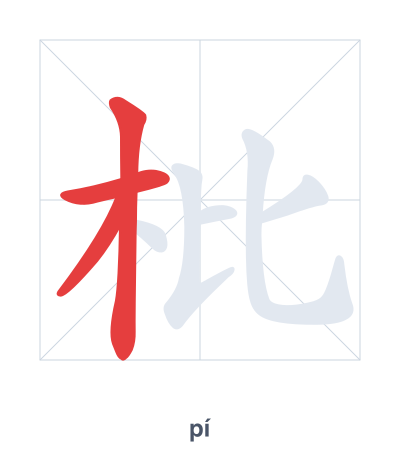
Open Hanzi Writer to see the animated stroke order and practice writing 枇 with real-time feedback.
The character 枇 (pí) is written with 8 strokes. Follow the standard Chinese stroke order: top to bottom, left to right, outside before inside. The radical 木 is one of its key components.
Practice the correct stroke order with the Hanzi Writer app to see animated stroke-by-stroke guidance with real-time feedback.
枇 means loquat (used in 枇杷).
枇 is a phono-semantic compound combining the tree radical 木 with 比 (pí) as a phonetic hint. The character specifically refers to the loquat tree, with 木 indicating it is a type of tree and 比 (meaning 'compare' or 'pair') loosely suggesting the paired clusters of loquat fruits.
💡 Memory Tip: Imagine a tree (木) with two identical loquat fruits side by side, inviting you to compare (比) which one is riper.
我喜欢吃枇杷。
wǒ xǐ huān chī pí pá
I like eating loquats.
喝点枇杷露。
hē diǎn pí pá lù
Have some loquat extract.
枇杷叶可以入药。
pí pá yè kě yǐ rù yào
Loquat leaves can be used as medicine.
Open Hanzi Writer to see the animated stroke order and practice writing 枇 with real-time feedback.
✨ Animated stroke order · Handwriting recognition · HSK-graded practice · Free to use
枇 is a left-right character. The left side is 木 (wood/tree), indicating it relates to a tree or plant. The right side is 比 (bǐ), which gives a clue to the pronunciation pí.