衄 (nǜ) means "Nosebleed" in Chinese. It has 10 strokes with the radical 血.
Rated 4.2/5 in difficulty (advanced).
Appears in 3+ common words including 鼻衄 (bí nǜ), 衄血 (nǜ xuè), 挫衄 (cuò nǜ).
Due to its 10 strokes, Hanzi Writer's error detection shows 衄 requires focused practice — most learners need 10+ attempts for consistent accuracy.
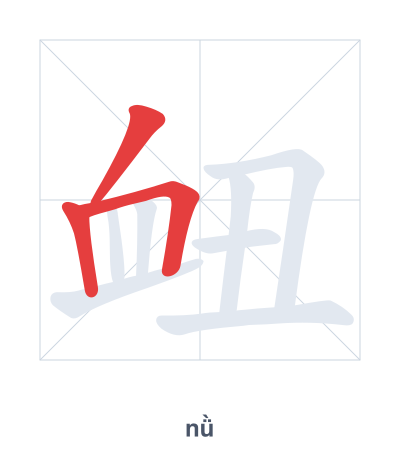
Open Hanzi Writer to see the animated stroke order and practice writing 衄 with real-time feedback.
The character 衄 (nǜ) is written with 10 strokes. Follow the standard Chinese stroke order: top to bottom, left to right, outside before inside. The radical 血 is one of its key components.
Practice the correct stroke order with the Hanzi Writer app to see animated stroke-by-stroke guidance with real-time feedback.
衄 means Nosebleed.
| Character | 衄 |
| Pinyin | nǜ (nv) |
| Meaning | Nosebleed |
| Strokes | 10 |
| Radical | 血 |
| Difficulty | 4.2/5 |
衄 is a phono-semantic compound where 血 (blood) indicates the meaning and 丑 (chǒu) provides a phonetic hint. The character directly conveys the idea of blood coming from the nose, i.e., a nosebleed.
💡 Memory Tip: Picture a bloody nose (血) and a grimacing face (丑) twisted in pain from the nosebleed.
天气太干容易鼻衄。
tiān qì tài gàn róng yì bí nǜ
The weather is so dry that it's easy to get a nosebleed.
他经常发生衄血。
tā jīng cháng fā shēng nǜ xuè
He often has nosebleeds.
球队遇到了小挫衄。
qiú duì yù dào le xiǎo cuò nǜ
The team suffered a minor setback.
Open Hanzi Writer to see the animated stroke order and practice writing 衄 with real-time feedback.
✨ Animated stroke order · Handwriting recognition · HSK-graded practice · Free to use
衄 is composed of the radical 血 (blood) on the left and the phonetic component 丑 (chǒu) on the right. Since a nosebleed involves blood, the radical directly connects to the meaning, while 丑 provides a hint for pronunciation (nǜ).