钼 (mù) means "molybdenum" in Chinese. It has 10 strokes with the radical 钅.
Rated 4.2/5 in difficulty (advanced).
Appears in 3+ common words including 钼钢 (mù gāng), 钼矿 (mù kuàng), 钼肥 (mù féi).
Due to its 10 strokes, Hanzi Writer's error detection shows 钼 requires focused practice — most learners need 10+ attempts for consistent accuracy.
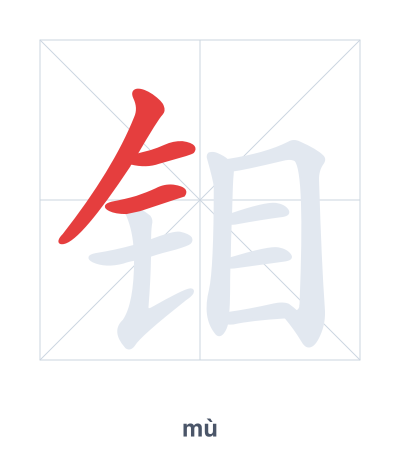
Open Hanzi Writer to see the animated stroke order and practice writing 钼 with real-time feedback.
The character 钼 (mù) is written with 10 strokes. Follow the standard Chinese stroke order: top to bottom, left to right, outside before inside. The radical 钅 is one of its key components.
Practice the correct stroke order with the Hanzi Writer app to see animated stroke-by-stroke guidance with real-time feedback.
钼 means molybdenum.
钼 is a modern phono-semantic compound created for the element molybdenum. The metal radical 钅 indicates its metallic nature, while 目 (eye) provides the pronunciation 'mù'—much like how a metal eye sees the atomic number 42.
💡 Memory Tip: Picture a metal eye (目) made of shiny molybdenum alloy peering through a microscope at a numbered sample.
这种刀是用钼钢做的。
zhè zhǒng dāo shì yòng mù gāng zuò de
This knife is made of molybdenum steel.
这个山区有丰富的钼矿。
zhè ge shān qū yǒu fēng fù de mù kuàng
This mountain area is rich in molybdenum ore.
农民在田里施了钼肥。
nóng mín zài tián lǐ shī le mù féi
Farmers applied molybdenum fertilizer in the field.
Open Hanzi Writer to see the animated stroke order and practice writing 钼 with real-time feedback.
✨ Animated stroke order · Handwriting recognition · HSK-graded practice · Free to use
钼 is a left-right character. The left radical 钅 means "metal" or "gold," and the right part 目 (mù) provides the pronunciation. Together, they form a character that names the metal molybdenum.