苜 (mù) means "alfalfa" in Chinese. It has 8 strokes with the radical 艹.
Rated 3.7/5 in difficulty (challenging).
Appears in 3+ common words including 苜蓿 (mù xu), 苜蓿草 (mù xu cǎo), 种苜蓿 (zhǒng mù xu).
Due to its 8 strokes, Hanzi Writer's error detection shows 苜 requires focused practice — most learners need 10+ attempts for consistent accuracy.
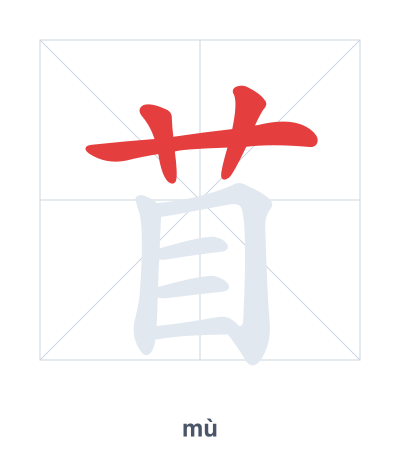
Open Hanzi Writer to see the animated stroke order and practice writing 苜 with real-time feedback.
The character 苜 (mù) is written with 8 strokes. Follow the standard Chinese stroke order: top to bottom, left to right, outside before inside. The radical 艹 is one of its key components.
Practice the correct stroke order with the Hanzi Writer app to see animated stroke-by-stroke guidance with real-time feedback.
苜 means alfalfa.
苜 is a phono-semantic compound: the radical 艹 (grass) indicates it's a plant, while 目 (eye) gives the sound mù. Together, they form the word for alfalfa, a leafy plant often used as animal feed.
💡 Memory Tip: Picture a field of alfalfa so tall that only an eye (目) peeking through the grass (艹) can spot it.
牛在吃苜蓿。
niú zài chī mù xu
The cow is eating alfalfa.
地里长满了苜蓿草。
dì lǐ zhǎng mǎn le mù xu cǎo
The field is full of alfalfa.
他在农场种苜蓿。
tā zài nóng chǎng zhǒng mù xu
He is growing alfalfa on the farm.
Open Hanzi Writer to see the animated stroke order and practice writing 苜 with real-time feedback.
✨ Animated stroke order · Handwriting recognition · HSK-graded practice · Free to use
The character 苜 is made of two parts: the grass radical 艹 on top and the character 目 (eye) on the bottom. The 艹 shows that 苜 is a type of plant (alfalfa), while 目 provides a clue to its pronunciation, which is mù, the same as 目.