茉 (mò) means "Jasmine" in Chinese. It has 8 strokes with the radical 艹.
Rated 3.7/5 in difficulty (challenging).
Appears in 3+ common words including 茉莉 (mò lì), 茉莉茶 (mò lì chá), 茉莉花 (mò lì huā).
Due to its 8 strokes, Hanzi Writer's error detection shows 茉 requires focused practice — most learners need 10+ attempts for consistent accuracy.
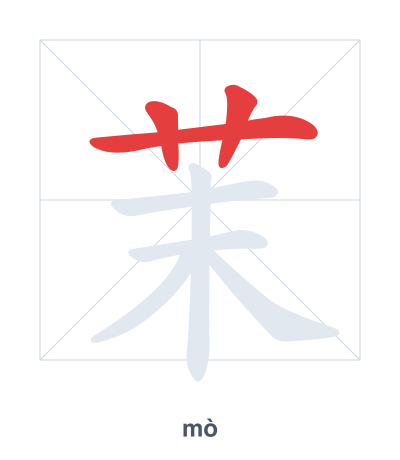
Open Hanzi Writer to see the animated stroke order and practice writing 茉 with real-time feedback.
The character 茉 (mò) is written with 8 strokes. Follow the standard Chinese stroke order: top to bottom, left to right, outside before inside. The radical 艹 is one of its key components.
Practice the correct stroke order with the Hanzi Writer app to see animated stroke-by-stroke guidance with real-time feedback.
茉 means Jasmine.
茉 is a compound character: the top part 艹 (grass radical) indicates it's a plant, and the bottom part 末 (mò, meaning 'tip' or 'end') gives the sound. Jasmine flowers often bloom at the tips of branches, linking the meaning to the 'end' component.
💡 Memory Tip: Picture a jasmine flower blooming at the very tip (末) of a green grass (艹) stem.
茉莉花很香。
mò lì huā hěn xiāng
Jasmine flowers are very fragrant.
我想喝茉莉茶。
wǒ xiǎng hē mò lì chá
I want to drink jasmine tea.
这是一朵茉莉花。
zhè shì yī duǒ mò lì huā
This is a jasmine flower.
Open Hanzi Writer to see the animated stroke order and practice writing 茉 with real-time feedback.
✨ Animated stroke order · Handwriting recognition · HSK-graded practice · Free to use
茉 is a semantic-phonetic compound made of two parts: the top radical 艹 (grass) and the bottom part 末 (mò, meaning 'tip' or 'end'). The grass radical tells you that this character is related to plants, and 末 provides the pronunciation as well as a hint that jasmine flowers appear at the tips of branches.