囵 (lún) means "Whole / Complete" in Chinese. It has 7 strokes with the radical 囗.
Rated 3.5/5 in difficulty (challenging).
Appears in 3+ common words including 囫囵 (hú lún), 囫囵个儿 (hú lún gè ér), 囫囵话 (hú lún huà).
Due to its 7 strokes, Hanzi Writer's error detection shows 囵 requires focused practice — most learners need 10+ attempts for consistent accuracy.
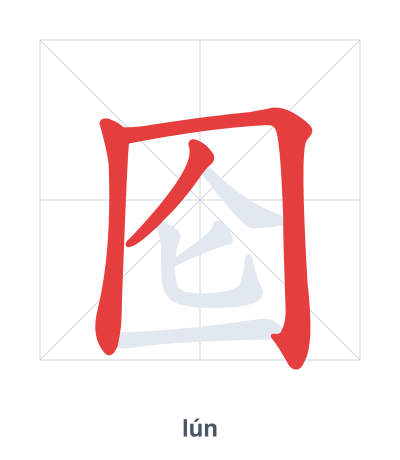
Open Hanzi Writer to see the animated stroke order and practice writing 囵 with real-time feedback.
The character 囵 (lún) is written with 7 strokes. Follow the standard Chinese stroke order: top to bottom, left to right, outside before inside. The radical 囗 is one of its key components.
Practice the correct stroke order with the Hanzi Writer app to see animated stroke-by-stroke guidance with real-time feedback.
囵 means Whole / Complete.
囵 is a phono-semantic compound: the outer radical 囗 (enclosure) represents containing something to make it whole, while 仑 (lún, meaning 'order' or 'arrangement') provides the pronunciation and hints at the internal order of a complete entity. It is most commonly used in the word 囫囵 (húlún), meaning 'whole' or 'entire', like a fruit swallowed without biting.
💡 Memory Tip: Imagine a circular enclosure (囗) where all the scattered parts are arranged neatly (仑) into a single, perfect whole—like a puzzle fully assembled.
他囫囵吞枣地看书。
tā hú lún tūn zǎo dì kàn shū
He read the book without truly understanding it.
苹果要吃囫囵个儿。
píng guǒ yào chī hú lún gè ér
Apples should be eaten whole.
他说了一句囫囵话。
tā shuō le yī jù hú lún huà
He said something vague and unclear.
Open Hanzi Writer to see the animated stroke order and practice writing 囵 with real-time feedback.
✨ Animated stroke order · Handwriting recognition · HSK-graded practice · Free to use
囵 is composed of the radical 囗, which means an enclosure or boundary, and the component 仑 (lún), which suggests order or logic. Together, they indicate something complete and orderly within a closed space, hence the meaning "whole" or "complete."