鳞 (lín) means "scale" in Chinese. It has 20 strokes with the radical 鱼.
Rated 4.2/5 in difficulty (advanced).
Appears in 3+ common words including 鱼鳞 (yú lín), 鳞片 (lín piàn), 金鳞 (jīn lín).
Due to its 20 strokes, Hanzi Writer's error detection shows 鳞 requires focused practice — most learners need 10+ attempts for consistent accuracy.
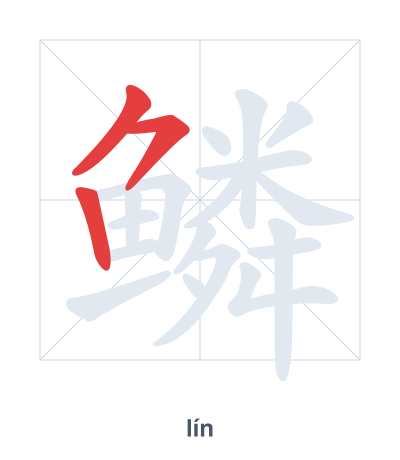
Open Hanzi Writer to see the animated stroke order and practice writing 鳞 with real-time feedback.
The character 鳞 (lín) is written with 20 strokes. Follow the standard Chinese stroke order: top to bottom, left to right, outside before inside. The radical 鱼 is one of its key components.
Practice the correct stroke order with the Hanzi Writer app to see animated stroke-by-stroke guidance with real-time feedback.
鳞 means scale.
鳞 is a phono-semantic compound. The left radical 鱼 (fish) indicates the meaning relates to fish, while the right component 粦 (lín) provides the pronunciation. 粦 originally depicted a firefly or shimmering light, which may hint at the glistening appearance of fish scales.
💡 Memory Tip: Picture a fish (鱼) whose scales glow like a swarm of fireflies (粦), each scale a tiny light shimmering on its body.
做鱼前要刮掉鱼鳞。
zuò yú qián yào guā diào yú lín
Scale the fish before cooking it.
鱼身上有很多鳞片。
yú shēn shàng yǒu hěn duō lín piàn
There are many scales on the fish's body.
这条鱼有金色的鳞。
zhè tiáo yú yǒu jīn sè de lín
This fish has golden scales.
Open Hanzi Writer to see the animated stroke order and practice writing 鳞 with real-time feedback.
✨ Animated stroke order · Handwriting recognition · HSK-graded practice · Free to use
鳞 is composed of the radical 鱼 (fish) on the left and the phonetic component 粦 (lín) on the right. The fish radical suggests the character is related to fish, and the overall meaning 'scale' comes from fish scales being a common association.