龛 (kān) means "Niche or shrine (for a statue or tablet)" in Chinese. It has 11 strokes with the radical 龙.
Rated 4.2/5 in difficulty (advanced).
Appears in 3+ common words including 佛龛 (fó kān), 神龛 (shén kān), 壁龛 (bì kān).
Due to its 11 strokes, Hanzi Writer's error detection shows 龛 requires focused practice — most learners need 10+ attempts for consistent accuracy.
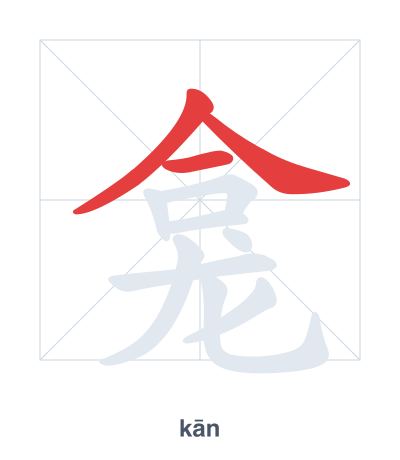
Open Hanzi Writer to see the animated stroke order and practice writing 龛 with real-time feedback.
The character 龛 (kān) is written with 11 strokes. Follow the standard Chinese stroke order: top to bottom, left to right, outside before inside. The radical 龙 is one of its key components.
Practice the correct stroke order with the Hanzi Writer app to see animated stroke-by-stroke guidance with real-time feedback.
龛 means Niche or shrine (for a statue or tablet).
| Character | 龛 |
| Pinyin | kān (kan) |
| Meaning | Niche or shrine (for a statue or tablet) |
| Strokes | 11 |
| Radical | 龙 |
| Difficulty | 4.2/5 |
This character combines 龙 (dragon), symbolizing sacred power, with 合 (join/close), suggesting a contained space. Together they depict a niche or shrine where a revered statue or tablet is placed, often associated with Buddhist or ancestral worship. The dragon component underscores the sanctity of the enclosure.
💡 Memory Tip: Picture a dragon (龙) curled up inside a small closed box (合), as if enshrined in a sacred niche.
墙上有一个佛龛。
qiáng shàng yǒu yí gè fó kān
There is a Buddhist shrine on the wall.
他在神龛前放了花。
tā zài shén kān qián fàng le huā
He placed flowers in front of the shrine.
书架旁边有个壁龛。
shū jià páng biān yǒu gè bì kān
There is a niche next to the bookshelf.
Open Hanzi Writer to see the animated stroke order and practice writing 龛 with real-time feedback.
✨ Animated stroke order · Handwriting recognition · HSK-graded practice · Free to use
龛 is composed of 合 (hé, meaning 'to combine' or 'to close') on top and 龙 (lóng, meaning 'dragon') below. The idea is that a niche or shrine is a closed space (合) that may house a sacred image, and the dragon symbolizes something powerful or divine. Thus, the structure visually suggests a container for a revered object.