刭 (jǐng) means "To cut the throat." in Chinese. It has 7 strokes with the radical 刂.
Rated 3.2/5 in difficulty (challenging).
Appears in 3+ common words including 自刭 (zì jǐng), 刎刭 (wěn jǐng), 刭杀 (jǐng shā).
Due to its 7 strokes, Hanzi Writer's error detection shows 刭 requires focused practice — most learners need 10+ attempts for consistent accuracy.
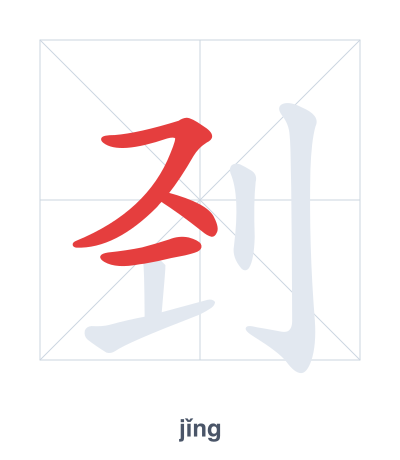
Open Hanzi Writer to see the animated stroke order and practice writing 刭 with real-time feedback.
The character 刭 (jǐng) is written with 7 strokes. Follow the standard Chinese stroke order: top to bottom, left to right, outside before inside. The radical 刂 is one of its key components.
Practice the correct stroke order with the Hanzi Writer app to see animated stroke-by-stroke guidance with real-time feedback.
刭 means To cut the throat..
刭 combines the radical 刂 (knife) with the phonetic component 巠 (jǐng, originally depicting a straight water channel). The knife on the right indicates the action of cutting, while the left part provides pronunciation and visually suggests a straight line — like a clean cut across the throat.
💡 Memory Tip: Imagine a straight knife (刂) slicing across a neck shaped like the left side (巠) — a clean, fatal cut to the throat.
他在绝望中自刭。
tā zài jué wàng zhōng zì jǐng
He committed suicide by slitting his throat in despair.
这是一个古老的词语。
zhè shì yí gè gǔ lǎo de cí yǔ
This is an ancient term.
这个词在现代很少用。
zhè ge cí zài xiàn dài hěn shǎo yòng
This word is rarely used in modern times.
Open Hanzi Writer to see the animated stroke order and practice writing 刭 with real-time feedback.
✨ Animated stroke order · Handwriting recognition · HSK-graded practice · Free to use
Left side is 巠 (jīng), which gives the sound, and right side is 刂 (knife radical), indicating cutting. Together, the character literally means 'cut the throat.' The knife radical directly connects to the action of slitting, while the left component provides pronunciation.