宦 (huàn) means "Official; eunuch." in Chinese. It has 9 strokes with the radical 宀.
Rated 4/5 in difficulty (challenging).
Appears in 3+ common words including 宦官 (huàn guān), 官宦 (guān huàn), 宦海 (huàn hǎi).
Due to its 9 strokes, Hanzi Writer's error detection shows 宦 requires focused practice — most learners need 10+ attempts for consistent accuracy.
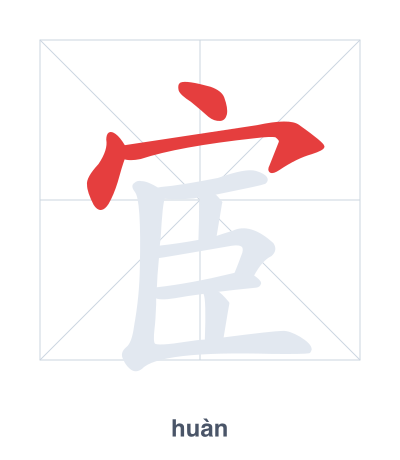
Open Hanzi Writer to see the animated stroke order and practice writing 宦 with real-time feedback.
The character 宦 (huàn) is written with 9 strokes. Follow the standard Chinese stroke order: top to bottom, left to right, outside before inside. The radical 宀 is one of its key components.
Practice the correct stroke order with the Hanzi Writer app to see animated stroke-by-stroke guidance with real-time feedback.
宦 means Official; eunuch..
The character 宦 combines the radical 宀 (roof, representing a palace or household) with 臣 (minister or official), depicting an official serving under a roof—i.e., a palace attendant. Historically, eunuchs were often employed as such officials within the imperial palace.
💡 Memory Tip: Under the palace roof (宀), a kneeling minister (臣) has lost his manhood to become a eunuch official.
历史书上有宦官。
lì shǐ shū shàng yǒu huàn guān
There are eunuchs in history books.
他出生在官宦之家。
tā chū shēng zài guān huàn zhī jiā
He was born into a family of officials.
他在宦海多年。
tā zài huàn hǎi duō nián
He has been in the political circles for many years.
Open Hanzi Writer to see the animated stroke order and practice writing 宦 with real-time feedback.
✨ Animated stroke order · Handwriting recognition · HSK-graded practice · Free to use
宦 is made of the radical 宀 (roof) above the component 臣 (minister). The roof suggests a palace or official building, and 臣 represents a minister or official, so together they indicate an official or eunuch serving in the palace.