韩 (hán) means "Korea; a surname" in Chinese. It has 12 strokes with the radical 韦.
Rated 4.2/5 in difficulty (advanced).
Appears in 3+ common words including 韩国 (hán guó), 韩语 (hán yǔ), 韩剧 (hán jù).
Due to its 12 strokes, Hanzi Writer's error detection shows 韩 requires focused practice — most learners need 10+ attempts for consistent accuracy.
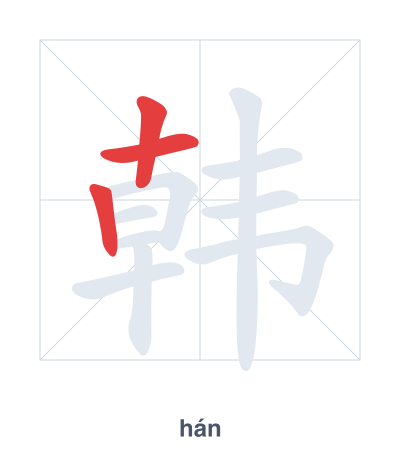
Open Hanzi Writer to see the animated stroke order and practice writing 韩 with real-time feedback.
The character 韩 (hán) is written with 12 strokes. Follow the standard Chinese stroke order: top to bottom, left to right, outside before inside. The radical 韦 is one of its key components.
Practice the correct stroke order with the Hanzi Writer app to see animated stroke-by-stroke guidance with real-time feedback.
韩 means Korea; a surname.
| Character | 韩 |
| Pinyin | hán (han) |
| Meaning | Korea; a surname |
| Strokes | 12 |
| Radical | 韦 |
| Difficulty | 4.2/5 |
The character 韩 (hán) is a phono-semantic compound. Its left side, the radical 韦 (simplified from 韋), means 'tanned leather,' and the right side (originally 倝, meaning 'sunrise') provided the phonetic element. The character was first used as the name of an ancient Chinese state, and later came to refer to Korea as a whole.
💡 Memory Tip: Picture a Korean man wearing a leather jacket (韦) and standing next to a sign that looks like a tall pole with a crossbar (the right side shape resembling 十 over 乚).
我明年想去韩国旅游。
wǒ míng nián xiǎng qù hán guó lǚ yóu
I want to travel to South Korea next year.
他在大学学习韩语。
tā zài dà xué xué xí hán yǔ
He is studying Korean at the university.
我妈妈喜欢看韩剧。
wǒ mā mā xǐ huān kàn hán jù
My mom likes watching Korean dramas.
Open Hanzi Writer to see the animated stroke order and practice writing 韩 with real-time feedback.
✨ Animated stroke order · Handwriting recognition · HSK-graded practice · Free to use
韩 combines 韦 (leather) on the left and 倝 (sunrise) on the right. The original meaning was a kind of deer or a place name, but today it mainly refers to Korea or a surname, with the leather component hinting at ancient Korean armor or clothing.