舸 (gě) means "Large boat" in Chinese. It has 11 strokes with the radical 舟.
Rated 4.2/5 in difficulty (advanced).
Appears in 3+ common words including 百舸 (bǎi gě), 巨舸 (jù gě), 舸舰 (gě jiàn).
Due to its 11 strokes, Hanzi Writer's error detection shows 舸 requires focused practice — most learners need 10+ attempts for consistent accuracy.
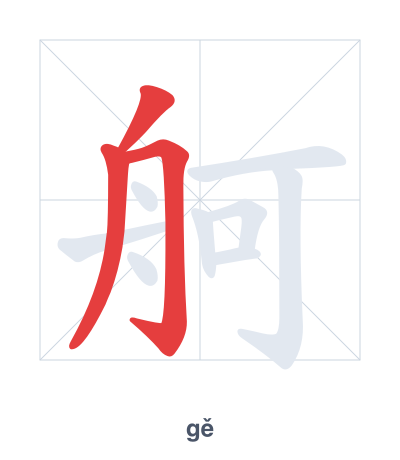
Open Hanzi Writer to see the animated stroke order and practice writing 舸 with real-time feedback.
The character 舸 (gě) is written with 11 strokes. Follow the standard Chinese stroke order: top to bottom, left to right, outside before inside. The radical 舟 is one of its key components.
Practice the correct stroke order with the Hanzi Writer app to see animated stroke-by-stroke guidance with real-time feedback.
舸 means Large boat.
舸 is a phono-semantic compound combining the radical 舟 (boat) with 可 (gě, a phonetic component that gives the sound). The character specifically refers to a large, often majestic vessel, as seen in ancient Chinese texts like the Classic of Poetry.
💡 Memory Tip: Picture a giant boat (舟) with a huge 'can' (可) on it, so big it can carry anything—that's your large boat, 舸.
江面上百舸争流。
jiāng miàn shàng bǎi gě zhēng liú
Hundreds of boats are racing on the river.
远方有一艘巨舸。
yuǎn fāng yǒu yī sōu jù gě
There is a huge boat in the distance.
这里的舸舰很多。
zhè lǐ de gě jiàn hěn duō
There are many large ships here.
Open Hanzi Writer to see the animated stroke order and practice writing 舸 with real-time feedback.
✨ Animated stroke order · Handwriting recognition · HSK-graded practice · Free to use
舸 is composed of the radical 舟 (boat) on the left and 可 (kě) on the right. The radical gives the meaning related to boats, while 可 provides a hint for the pronunciation gě. Together they form a character meaning 'large boat'.