苷 (gān) means "Glycoside" in Chinese. It has 8 strokes with the radical 艹.
Rated 3.7/5 in difficulty (challenging).
Appears in 3+ common words including 苷 (gān), 糖苷 (táng gān), 苷元 (gān yuán).
Due to its 8 strokes, Hanzi Writer's error detection shows 苷 requires focused practice — most learners need 10+ attempts for consistent accuracy.
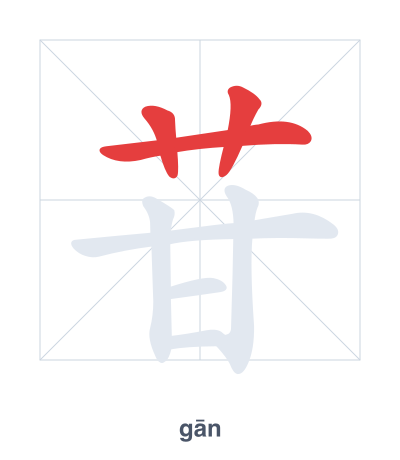
Open Hanzi Writer to see the animated stroke order and practice writing 苷 with real-time feedback.
The character 苷 (gān) is written with 8 strokes. Follow the standard Chinese stroke order: top to bottom, left to right, outside before inside. The radical 艹 is one of its key components.
Practice the correct stroke order with the Hanzi Writer app to see animated stroke-by-stroke guidance with real-time feedback.
苷 means Glycoside.
苷 is a compound character: the radical 艹 (grass/plant) indicates it relates to plants, and the phonetic component 甘 (gān, sweet) hints both at the pronunciation and the sweet taste of many glycosides found in plants.
💡 Memory Tip: Picture a sweet (甘) blade of grass (艹) that, when chewed, releases a medicinal glycoside.
苷类物质在植物中常见。
gān lèi wù zhì zài zhí wù zhōng cháng jiàn
Glycosides are common in plants.
糖苷具有多种功效。
táng gān jù yǒu duō zhǒng gōng xiào
Glycosides have various benefits.
这是苷元的化学式。
zhè shì gān yuán de huà xué shì
This is the chemical formula of aglycone.
Open Hanzi Writer to see the animated stroke order and practice writing 苷 with real-time feedback.
✨ Animated stroke order · Handwriting recognition · HSK-graded practice · Free to use
The character 苷 is made of two parts: the radical 艹 (grass) on top and 甘 (sweet) on the bottom. This fits its meaning because glycosides are natural compounds found in plants, many of which taste sweet.