枫 (fēng) means "maple" in Chinese. It has 8 strokes with the radical 木.
Rated 3.7/5 in difficulty (challenging).
Appears in 3+ common words including 枫叶 (fēng yè), 枫树 (fēng shù), 枫林 (fēng lín).
Due to its 8 strokes, Hanzi Writer's error detection shows 枫 requires focused practice — most learners need 10+ attempts for consistent accuracy.
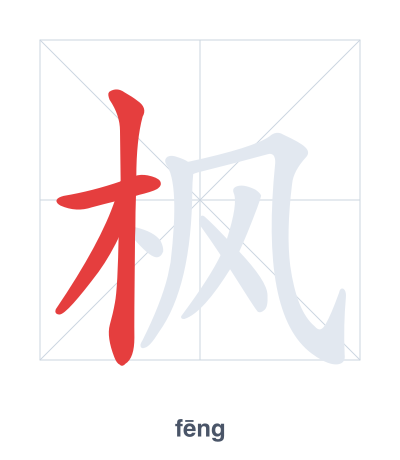
Open Hanzi Writer to see the animated stroke order and practice writing 枫 with real-time feedback.
The character 枫 (fēng) is written with 8 strokes. Follow the standard Chinese stroke order: top to bottom, left to right, outside before inside. The radical 木 is one of its key components.
Practice the correct stroke order with the Hanzi Writer app to see animated stroke-by-stroke guidance with real-time feedback.
枫 means maple.
枫 is a phono-semantic compound: the tree radical 木 (wood) indicates a type of tree, while 风 (fēng, 'wind') supplies the pronunciation. This pairs the maple tree with the sound of wind, as maple leaves are known to flutter noisily in the breeze.
💡 Memory Tip: Picture a maple tree (木) standing in a gust of wind (风) that blows all its star-shaped leaves into a swirling red storm.
秋天的枫叶很红。
qiū tiān de fēng yè hěn hóng
The maple leaves in autumn are very red.
路上种了很多枫树。
lù shàng zhǒng le hěn duō fēng shù
Many maple trees are planted along the road.
我们去枫林散步。
wǒ men qù fēng lín sàn bù
Let's go for a walk in the maple forest.
Open Hanzi Writer to see the animated stroke order and practice writing 枫 with real-time feedback.
✨ Animated stroke order · Handwriting recognition · HSK-graded practice · Free to use
枫 is made of the radical 木 (wood/tree) on the left and 风 (wind, pronounced fēng) on the right. The 木 shows that it is a type of tree, while 风 provides the pronunciation and may suggest the tree's leaves rustling in the wind.