朿 (cì) means "thorn (ancient character)" in Chinese. It has 6 strokes with the radical 木.
Rated 3.2/5 in difficulty (challenging).
Appears in 1+ common words including 朿 (cì).
Due to its 6 strokes, Hanzi Writer's error detection shows 朿 requires focused practice — most learners need 10+ attempts for consistent accuracy.
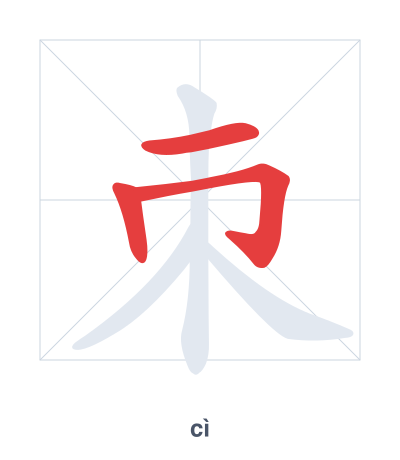
Open Hanzi Writer to see the animated stroke order and practice writing 朿 with real-time feedback.
The character 朿 (cì) is written with 6 strokes. Follow the standard Chinese stroke order: top to bottom, left to right, outside before inside. The radical 木 is one of its key components.
Practice the correct stroke order with the Hanzi Writer app to see animated stroke-by-stroke guidance with real-time feedback.
朿 means thorn (ancient character).
朿 is a pictograph of a thorn or a branch with spikes. Its ancient form depicted a tree (木) with thorns protruding, representing the sharp points. The modern shape retains the tree radical with added strokes symbolizing the thorns.
💡 Memory Tip: Imagine a tree (木) with a long sharp thorn (vertical line) running through its center, and two barbed branches (horizontal strokes) sticking out to the sides.
朿是一个古汉字。
cì shì yí gè gǔ hàn zì
'Ci' is an ancient Chinese character.
朿的意思是小刺。
cì de yì si shì xiǎo cì
'Ci' means a small thorn.
这个字现在很少用。
zhè ge zì xiàn zài hěn shǎo yòng
This character is rarely used now.
Open Hanzi Writer to see the animated stroke order and practice writing 朿 with real-time feedback.
✨ Animated stroke order · Handwriting recognition · HSK-graded practice · Free to use
The character 朿 has the radical 木 (tree/wood) at the bottom, representing a plant. Above 木, there is a shape that looks like a pointed thorn or spike. The whole character visually shows a tree with a thorn growing out of it, matching its meaning of 'thorn'.