怆 (chuàng) means "sorrowful; sad" in Chinese. It has 7 strokes with the radical 忄.
Rated 3.5/5 in difficulty (challenging).
Appears in 3+ common words including 悲怆 (bēi chuàng), 凄怆 (qī chuàng), 怆然 (chuàng rán).
Due to its 7 strokes, Hanzi Writer's error detection shows 怆 requires focused practice — most learners need 10+ attempts for consistent accuracy.
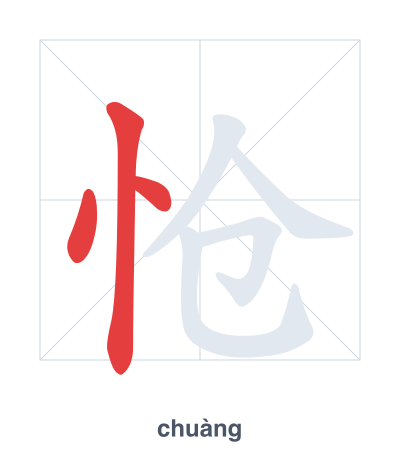
Open Hanzi Writer to see the animated stroke order and practice writing 怆 with real-time feedback.
The character 怆 (chuàng) is written with 7 strokes. Follow the standard Chinese stroke order: top to bottom, left to right, outside before inside. The radical 忄 is one of its key components.
Practice the correct stroke order with the Hanzi Writer app to see animated stroke-by-stroke guidance with real-time feedback.
怆 means sorrowful; sad.
The character 怆 combines the radical 忄 (heart, indicating emotion) with 仓 (cāng, a granary or storehouse) as a phonetic component. The heart radical points to a feeling, while the granary suggests an empty, cold space, evoking a sense of deep sorrow or grief.
💡 Memory Tip: Imagine your heart (忄) locked in a cold, empty storehouse (仓), leaving you feeling utterly sorrowful and alone.
音乐非常悲怆。
yīn yuè fēi cháng bēi chuàng
The music is very tragic and sorrowful.
晚风显得很凄怆。
wǎn fēng xiǎn de hěn qī chuàng
The evening breeze feels very desolate.
令人怆然泪下。
lìng rén chuàng rán lèi xià
It makes one shed tears of sorrow.
Open Hanzi Writer to see the animated stroke order and practice writing 怆 with real-time feedback.
✨ Animated stroke order · Handwriting recognition · HSK-graded practice · Free to use
The left side 忄 (heart radical) shows the meaning relates to emotions or feelings. The right side 仓 (倉) provides the sound chuàng and also suggests a sense of "storing" or "hiding" — together, the heart hides sorrow inside.