艟 (chōng) means "Ancient warship" in Chinese. It has 18 strokes with the radical 舟.
Rated 4.2/5 in difficulty (advanced).
Appears in 3+ common words including 艨艟 (méng chōng), 艟舰 (chōng jiàn), 艟艨 (chōng méng).
Due to its 18 strokes, Hanzi Writer's error detection shows 艟 requires focused practice — most learners need 10+ attempts for consistent accuracy.
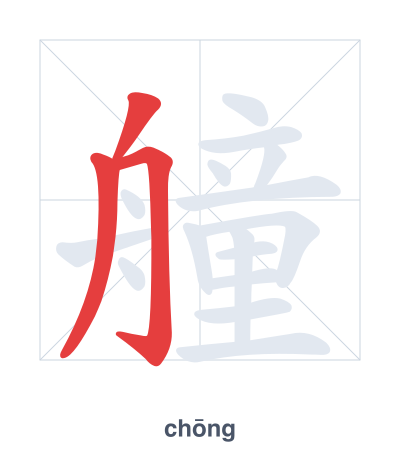
Open Hanzi Writer to see the animated stroke order and practice writing 艟 with real-time feedback.
The character 艟 (chōng) is written with 18 strokes. Follow the standard Chinese stroke order: top to bottom, left to right, outside before inside. The radical 舟 is one of its key components.
Practice the correct stroke order with the Hanzi Writer app to see animated stroke-by-stroke guidance with real-time feedback.
艟 means Ancient warship.
艟 is a phono-semantic compound character. The radical 舟 (boat) indicates its meaning as a vessel, while the phonetic component 童 (child, tóng) provides the pronunciation chōng. It specifically denotes a large, multi-decked warship used in ancient Chinese naval warfare.
💡 Memory Tip: Imagine a child (童) captaining a massive warship (舟) and charging into battle with a fierce roar: 'CHONG!'
艨艟是古代战船。
méng chōng shì gǔ dài zhàn chuán
The Mongchong is an ancient warship.
艟舰气势雄伟。
chōng jiàn qì shì xióng wěi
The warship looks magnificent.
艟艨在水上列队。
chōng méng zài shuǐ shàng liè duì
The warships are lined up on the water.
Open Hanzi Writer to see the animated stroke order and practice writing 艟 with real-time feedback.
✨ Animated stroke order · Handwriting recognition · HSK-graded practice · Free to use
The character 艟 is composed of the radical 舟 (boat/ship) on the left, which hints at its nautical meaning. The right part 童 (child, but here purely phonetic) gives the pronunciation chōng, making this a semantic-phonetic compound where the radical provides meaning and the other part provides sound.