钗 (chāi) means "Hairpin" in Chinese. It has 8 strokes with the radical 钅.
Rated 3.7/5 in difficulty (challenging).
Appears in 3+ common words including 金钗 (jīn chāi), 发钗 (fā chāi), 玉钗 (yù chāi).
Due to its 8 strokes, Hanzi Writer's error detection shows 钗 requires focused practice — most learners need 10+ attempts for consistent accuracy.
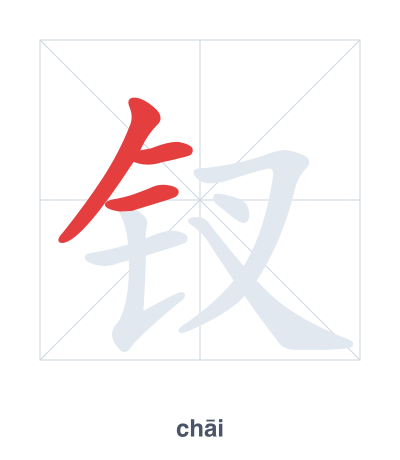
Open Hanzi Writer to see the animated stroke order and practice writing 钗 with real-time feedback.
The character 钗 (chāi) is written with 8 strokes. Follow the standard Chinese stroke order: top to bottom, left to right, outside before inside. The radical 钅 is one of its key components.
Practice the correct stroke order with the Hanzi Writer app to see animated stroke-by-stroke guidance with real-time feedback.
钗 means Hairpin.
钗 combines the radical 钅 (metal, indicating material) with 叉 (chā, 'fork'), which provides both pronunciation and a hint at the pronged shape of the hairpin. Ancient hairpins were often made of metal, so the character visually represents a metal fork-like object used to secure hair.
💡 Memory Tip: Picture a shiny metal fork (钅+叉) stuck into a bun as a fancy hairpin.
她头上戴着金钗。
tā tóu shàng dài zhe jīn chāi
She wore a golden hairpin on her head.
这个发钗很漂亮。
zhè ge fā chāi hěn piào liàng
This hairpin is very beautiful.
奶奶有一把玉钗。
nǎi nǎi yǒu yī bǎ yù chāi
Grandma has a jade hairpin.
Open Hanzi Writer to see the animated stroke order and practice writing 钗 with real-time feedback.
✨ Animated stroke order · Handwriting recognition · HSK-graded practice · Free to use
The character 钗 is composed of the radical 钅 (metal) on the left and 叉 (fork) on the right. The metal radical indicates that hairpins were often made of metal, while 叉 suggests the fork-like shape of a traditional hairpin. Together, they create the meaning of a metal hairpin.