钹 (bó) means "cymbals" in Chinese. It has 10 strokes with the radical 钅.
Rated 4.2/5 in difficulty (advanced).
Appears in 3+ common words including 敲钹 (qiāo bó), 铜钹 (tóng bó), 钹声 (bó shēng).
Due to its 10 strokes, Hanzi Writer's error detection shows 钹 requires focused practice — most learners need 10+ attempts for consistent accuracy.
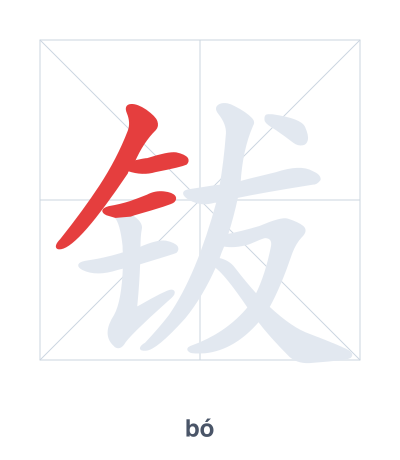
Open Hanzi Writer to see the animated stroke order and practice writing 钹 with real-time feedback.
The character 钹 (bó) is written with 10 strokes. Follow the standard Chinese stroke order: top to bottom, left to right, outside before inside. The radical 钅 is one of its key components.
Practice the correct stroke order with the Hanzi Writer app to see animated stroke-by-stroke guidance with real-time feedback.
钹 means cymbals.
钹 is a phono-semantic compound: the left side 钅 (metal) indicates that cymbals are made of metal, while the right side 犮 (bá) gives the sound (bó). The character was created specifically for this percussion instrument, reflecting its metallic nature and pronunciation.
💡 Memory Tip: Picture a metal (钅) dog (犮) clapping its paws together like cymbals with a loud 'BOK!' sound.
他在乐队里负责敲钹。
tā zài yuè duì lǐ fù zé qiāo bó
He is responsible for playing the cymbals in the band.
这对铜钹的声音很响。
zhè duì tóng bó de shēng yīn hěn xiǎng
This pair of cymbals sounds very loud.
远处传来了钹声。
yuǎn chù chuán lái le bó shēng
The sound of cymbals came from the distance.
Open Hanzi Writer to see the animated stroke order and practice writing 钹 with real-time feedback.
✨ Animated stroke order · Handwriting recognition · HSK-graded practice · Free to use
钹 is made of two parts: the radical 钅 (meaning metal) on the left, and the phonetic component 犮 on the right. Since cymbals are made of metal, the 钅 radical directly shows the material. The right side 犮 gives the pronunciation clue (bó).