苞 (bāo) means "bud / bract" in Chinese. It has 8 strokes with the radical 艹.
Rated 3.7/5 in difficulty (challenging).
Appears in 3+ common words including 花苞 (huā bāo), 苞米 (bāo mǐ), 含苞 (hán bāo).
Due to its 8 strokes, Hanzi Writer's error detection shows 苞 requires focused practice — most learners need 10+ attempts for consistent accuracy.
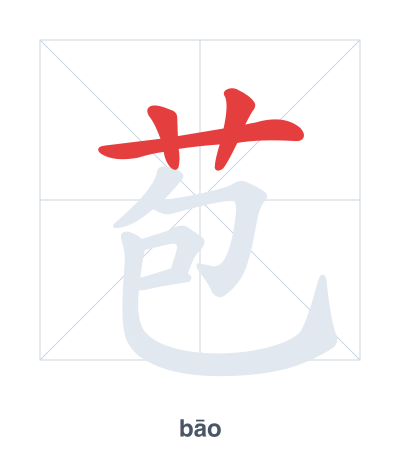
Open Hanzi Writer to see the animated stroke order and practice writing 苞 with real-time feedback.
The character 苞 (bāo) is written with 8 strokes. Follow the standard Chinese stroke order: top to bottom, left to right, outside before inside. The radical 艹 is one of its key components.
Practice the correct stroke order with the Hanzi Writer app to see animated stroke-by-stroke guidance with real-time feedback.
苞 means bud / bract.
苞 is a compound character combining the radical 艹 (grass, plants) with 包 (bāo, 'to wrap'), which also provides the sound. The character depicts a grass plant with a wrapped or enclosed part, referring to a flower bud or a bract that encloses the developing bloom.
💡 Memory Tip: Imagine a grassy plant (艹) with a tiny green package (包) that unwraps into a flower bud.
花苞快要开了。
huā bāo kuài yào kāi le
The flower bud is about to bloom.
我想吃烤苞米。
wǒ xiǎng chī kǎo bāo mǐ
I want to eat roasted corn.
花朵含苞待放。
huā duǒ hán bāo dài fàng
The flowers are in bud and ready to bloom.
Open Hanzi Writer to see the animated stroke order and practice writing 苞 with real-time feedback.
✨ Animated stroke order · Handwriting recognition · HSK-graded practice · Free to use
苞 is made of the radical 艹 (grass) on top and 包 (bāo, to wrap) below. The grass radical shows it is a plant part, while 包 suggests a wrapped or enclosed shape, which together describe a flower bud or bract.