沂 (yí) means "Yi (name of a river)" in Chinese. It has 7 strokes with the radical 氵.
Rated 3.5/5 in difficulty (challenging).
Appears in 3+ common words including 沂河 (yí hé), 沂蒙 (yí méng), 沂水 (yí shuǐ).
Due to its 7 strokes, Hanzi Writer's error detection shows 沂 requires focused practice — most learners need 10+ attempts for consistent accuracy.
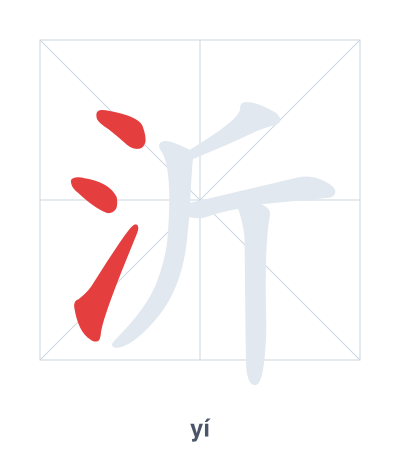
Open Hanzi Writer to see the animated stroke order and practice writing 沂 with real-time feedback.
The character 沂 (yí) is written with 7 strokes. Follow the standard Chinese stroke order: top to bottom, left to right, outside before inside. The radical 氵 is one of its key components.
Practice the correct stroke order with the Hanzi Writer app to see animated stroke-by-stroke guidance with real-time feedback.
沂 means Yi (name of a river).
沂 is a phono-semantic compound: the radical 氵 (water) indicates a river, and the component 斤 (axe) hints at the pronunciation (though not perfectly matching yí), together naming the Yi River in Shandong.
💡 Memory Tip: Picture an axe (斤) slicing through water (氵) to carve out the path of the Yi River.
沂河在山东。
yí hé zài shān dōng
The Yi River is in Shandong.
沂蒙山很漂亮。
yí méng shān hěn piào liàng
Yimeng Mountain is very beautiful.
沂水流向远方。
yí shuǐ liú xiàng yuǎn fāng
The Yi River flows into the distance.
Open Hanzi Writer to see the animated stroke order and practice writing 沂 with real-time feedback.
✨ Animated stroke order · Handwriting recognition · HSK-graded practice · Free to use
沂 is made of two parts: the left part 氵 (water radical) and the right part 斤 (jīn). The water radical shows that the character relates to a river or water, and 斤 provides the pronunciation. Together, 沂 means the Yi River, a proper name for a river in China.