兖 (yǎn) means "Yan (ancient Chinese province)" in Chinese. It has 8 strokes with the radical 亠.
Rated 3.4/5 in difficulty (challenging).
Appears in 3+ common words including 兖州 (yǎn zhōu), 兖矿 (yǎn kuàng), 兖绣 (yǎn xiù).
Due to its 8 strokes, Hanzi Writer's error detection shows 兖 requires focused practice — most learners need 10+ attempts for consistent accuracy.
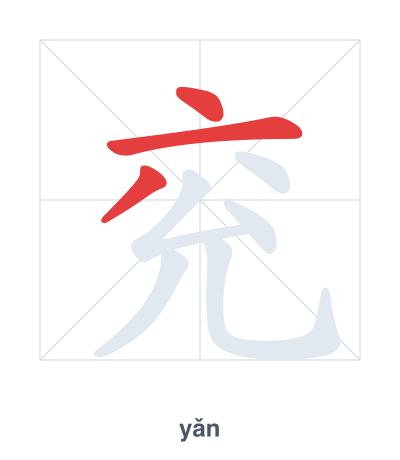
Open Hanzi Writer to see the animated stroke order and practice writing 兖 with real-time feedback.
The character 兖 (yǎn) is written with 8 strokes. Follow the standard Chinese stroke order: top to bottom, left to right, outside before inside. The radical 亠 is one of its key components.
Practice the correct stroke order with the Hanzi Writer app to see animated stroke-by-stroke guidance with real-time feedback.
兖 means Yan (ancient Chinese province).
| Character | 兖 |
| Pinyin | yǎn (yan) |
| Meaning | Yan (ancient Chinese province) |
| Strokes | 8 |
| Radical | 亠 |
| Difficulty | 3.4/5 |
兖 is a compound character consisting of the radical 亠 (lid or cover) and the phonetic component 允 (yǔn, meaning 'allow' or 'sincere'). It originally referred to Yan, one of the ancient Nine Provinces of China, possibly named after the Yan River. The top element may symbolize a boundary or administrative region, while 允 provides the sound and a sense of permission or governance.
💡 Memory Tip: Picture a governor's hat (亠) placed on a man (允) who was 'allowed' to rule the ancient province of Yan.
他住在山东兖州。
tā zhù zài shān dōng yǎn zhōu
He lives in Yanzhou, Shandong.
他在兖矿集团工作。
tā zài yǎn kuàng jí tuán gōng zuò
He works at Yankuang Group.
兖绣是当地的特产。
yǎn xiù shì dāng dì de tè chǎn
Yan embroidery is a local specialty.
Open Hanzi Writer to see the animated stroke order and practice writing 兖 with real-time feedback.
✨ Animated stroke order · Handwriting recognition · HSK-graded practice · Free to use
兖 is composed of the radical 亠 (lid or head) at the top, a middle part that resembles 允 (yǔn, to allow), and the bottom part 儿 (legs). The character represents an ancient province name, so the components do not directly hint at its meaning — it is a phonetic-semantic compound where 允 provides sound and 亠 plus 儿 form a decorative structure.