芫 (yán/yuán) means "Coriander / Daphne genkwa" in Chinese. It has 7 strokes with the radical 艹.
Rated 3.5/5 in difficulty (challenging).
Appears in 3+ common words including 芫荽 (yán suī), 芫花 (yuán huā), 芫爆 (yán bào).
Due to its 7 strokes, Hanzi Writer's error detection shows 芫 requires focused practice — most learners need 10+ attempts for consistent accuracy.
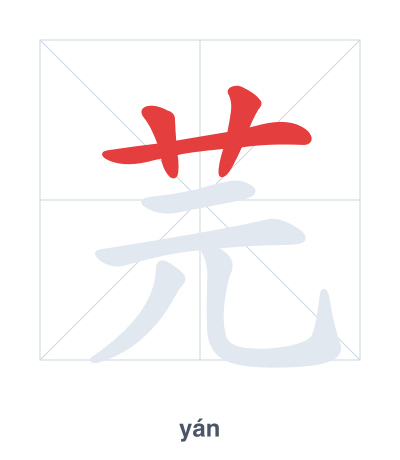
Open Hanzi Writer to see the animated stroke order and practice writing 芫 with real-time feedback.
The character 芫 (yán/yuán) is written with 7 strokes. Follow the standard Chinese stroke order: top to bottom, left to right, outside before inside. The radical 艹 is one of its key components.
Practice the correct stroke order with the Hanzi Writer app to see animated stroke-by-stroke guidance with real-time feedback.
芫 means Coriander / Daphne genkwa.
This is a polyphonic character with readings: yán, yuán.
This character combines the radical 艹 (grass) with 元 (yuán, meaning 'origin' or 'first'), indicating a plant name. It refers to coriander (芫荽) and the Daphne genkwa shrub, both notable for their strong scents or medicinal uses.
💡 Memory Tip: Picture a grassy patch (艹) with a round coin (元) growing as a coriander leaf, reminding you it's the 'origin' of flavor in many dishes.
我不想吃芫荽。
wǒ bù xiǎng chī yán suī
I don't want to eat cilantro.
芫花在春天开。
yuán huā zài chūn tiān kāi
Lilac daphne blooms in spring.
这道菜是芫爆肉丝。
zhè dào cài shì yán bào ròu sī
This dish is sautéed shredded pork with coriander.
Open Hanzi Writer to see the animated stroke order and practice writing 芫 with real-time feedback.
✨ Animated stroke order · Handwriting recognition · HSK-graded practice · Free to use
芫 combines the radical 艹 (grass/plant) on top with 元 (yuán, meaning "beginning" or "first") below. Since the radical indicates a plant, and 元 contributes pronunciation and a hint of "origin," the character refers to specific plants like coriander or lilac daphne.