毋 (wú) means "Do not; no; not." in Chinese. It has 4 strokes with the radical 毋.
Rated 2/5 in difficulty (beginner-friendly).
Appears in 3+ common words including 毋庸 (wú yōng), 毋宁 (wú nìng), 宁缺毋滥 (nìng quē wú làn).
In the Hanzi Writer app, most learners master 毋 within 3 practice attempts using stroke-by-stroke animation.
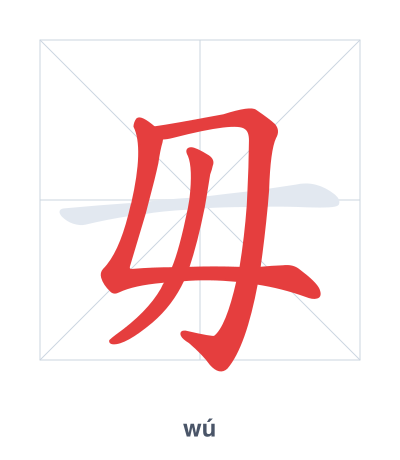
Open Hanzi Writer to see the animated stroke order and practice writing 毋 with real-time feedback.
The character 毋 (wú) is written with 4 strokes. Follow the standard Chinese stroke order: top to bottom, left to right, outside before inside. The radical 毋 is one of its key components.
Practice the correct stroke order with the Hanzi Writer app to see animated stroke-by-stroke guidance with real-time feedback.
毋 means Do not; no; not..
| Character | 毋 |
| Pinyin | wú (wu) |
| Meaning | Do not; no; not. |
| Strokes | 4 |
| Radical | 毋 |
| Difficulty | 2/5 |
The character 毋 originally depicted a woman with a horizontal line through her chest, derived from 母 (mother) to indicate prohibition. In ancient script, this line acted as a visual barrier, meaning 'do not' or 'not allowed'.
💡 Memory Tip: Picture a mother (母) with a strict horizontal 'no' line across her chest, forbidding her child with 'Do not!'
这事毋庸置疑。
zhè shì wú yōng zhì yí
This matter is beyond doubt.
毋宁死,不投降。
wú nìng sǐ bù tóu xiáng
Would rather die than surrender.
我们选人宁缺毋滥。
wǒ men xuǎn rén nìng quē wú làn
We would rather have no one than someone unsuitable.
Open Hanzi Writer to see the animated stroke order and practice writing 毋 with real-time feedback.
✨ Animated stroke order · Handwriting recognition · HSK-graded practice · Free to use
毋 is a simple pictograph that originally depicted a woman with a line through her, symbolizing prohibition or negation. As a radical itself, it functions as a whole character meaning 'do not' or 'no'. Its structure is not composed of other radicals but stands alone as a complete unit.