秫 (shú) means "glutinous millet" in Chinese. It has 10 strokes with the radical 禾.
Rated 4.2/5 in difficulty (advanced).
Appears in 3+ common words including 秫米 (shú mǐ), 秫秸 (shú jiē), 秫酒 (shú jiǔ).
Due to its 10 strokes, Hanzi Writer's error detection shows 秫 requires focused practice — most learners need 10+ attempts for consistent accuracy.
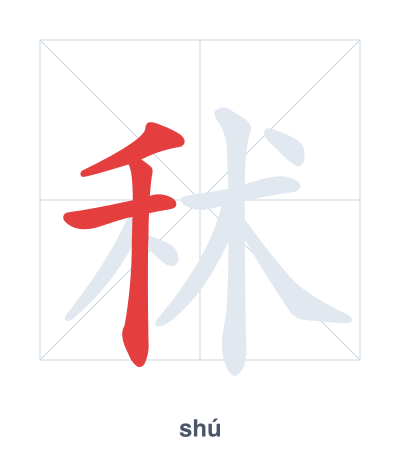
Open Hanzi Writer to see the animated stroke order and practice writing 秫 with real-time feedback.
The character 秫 (shú) is written with 10 strokes. Follow the standard Chinese stroke order: top to bottom, left to right, outside before inside. The radical 禾 is one of its key components.
Practice the correct stroke order with the Hanzi Writer app to see animated stroke-by-stroke guidance with real-time feedback.
秫 means glutinous millet.
秫 is a compound character combining the radical 禾 (grain) on the left and 术 (originally a pictograph of a plant with a drooping panicle) on the right, which also provides the pronunciation. The character specifically refers to glutinous millet, a sticky variety of grain used in making wine and food.
💡 Memory Tip: Picture a grain stalk (禾) with a big blob of sticky glue (the dot in 术) dripping down its branch to remind you of glutinous millet.
秫米是红色的。
shú mǐ shì hóng sè de
Glutinous millet is red.
秫秸长得很长。
shú jiē zhǎng dé hěn zhǎng
The millet stalks grow very long.
他喝了一口秫酒。
tā hē le yī kǒu shú jiǔ
He took a sip of sorghum wine.
Open Hanzi Writer to see the animated stroke order and practice writing 秫 with real-time feedback.
✨ Animated stroke order · Handwriting recognition · HSK-graded practice · Free to use
秫 is composed of the radical 禾 (grain) on the left and 术 (shù, technique) on the right. The 禾 shows that the character relates to a type of grain, while 术 provides phonetic cues for the pronunciation shú. Together, they form the meaning of glutinous millet, a sticky grain used in food and wine.