劭 (shào) means "Exhort; encourage; fine" in Chinese. It has 7 strokes with the radical 力.
Rated 3.2/5 in difficulty (challenging).
Appears in 3+ common words including 劭勉 (shào miǎn), 德劭 (dé shào), 劭农 (shào nóng).
Due to its 7 strokes, Hanzi Writer's error detection shows 劭 requires focused practice — most learners need 10+ attempts for consistent accuracy.
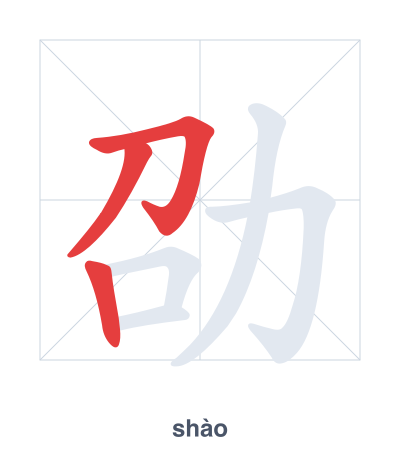
Open Hanzi Writer to see the animated stroke order and practice writing 劭 with real-time feedback.
The character 劭 (shào) is written with 7 strokes. Follow the standard Chinese stroke order: top to bottom, left to right, outside before inside. The radical 力 is one of its key components.
Practice the correct stroke order with the Hanzi Writer app to see animated stroke-by-stroke guidance with real-time feedback.
劭 means Exhort; encourage; fine.
Combines 召 (to summon, call) and 力 (strength, effort), suggesting using both words and physical force to urge or encourage someone.
💡 Memory Tip: A drill sergeant (召) uses all his strength (力) to shout encouragement at the recruits.
这种精神值得劭勉。
zhè zhǒng jīng shén zhí de shào miǎn
This spirit is worth encouraging.
这位老人年高德劭。
zhè wèi lǎo rén nián gāo dé shào
This elderly person is of advanced age and high character.
古代官员常会劭农。
gǔ dài guān yuán cháng huì shào nóng
Ancient officials often encouraged farming.
Open Hanzi Writer to see the animated stroke order and practice writing 劭 with real-time feedback.
✨ Animated stroke order · Handwriting recognition · HSK-graded practice · Free to use
劭 is composed of 召 (zhào, meaning 'call' or 'summon') on top and 力 (lì, meaning 'strength' or 'effort') below. The combination suggests using your strength to respond to a call, which relates to encouraging or exhorting others to action. This structure also supports the meaning of 'fine' or 'admirable', as making an effort is considered virtuous.