枘 (ruì) means "tenon" in Chinese. It has 8 strokes with the radical 木.
Rated 3.7/5 in difficulty (challenging).
Appears in 3+ common words including 枘凿 (ruì záo), 枘方 (ruì fāng), 枘圆 (ruì yuán).
Due to its 8 strokes, Hanzi Writer's error detection shows 枘 requires focused practice — most learners need 10+ attempts for consistent accuracy.
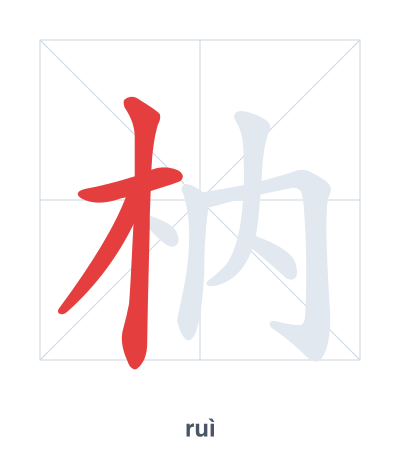
Open Hanzi Writer to see the animated stroke order and practice writing 枘 with real-time feedback.
The character 枘 (ruì) is written with 8 strokes. Follow the standard Chinese stroke order: top to bottom, left to right, outside before inside. The radical 木 is one of its key components.
Practice the correct stroke order with the Hanzi Writer app to see animated stroke-by-stroke guidance with real-time feedback.
枘 means tenon.
枘 combines the radical 木 (wood) with 内 (inside), literally meaning a wooden piece that goes inside another — the tenon that fits into a mortise.
💡 Memory Tip: Imagine a wooden block (木) slipping snugly inside (内) a matching hole to form a strong joint.
枘凿要配合好。
ruì záo yào pèi hé hǎo
The tenon and mortise must fit together well.
这是一个枘方。
zhè shì yí gè ruì fāng
This is a square tenon.
枘圆很难做。
ruì yuán hěn nán zuò
Round tenons are difficult to make.
Open Hanzi Writer to see the animated stroke order and practice writing 枘 with real-time feedback.
✨ Animated stroke order · Handwriting recognition · HSK-graded practice · Free to use
枘 is composed of the radical 木 (wood) on the left and 内 (inside) on the right. The wood radical shows it relates to woodworking, and 内 indicates that a tenon is a part that goes inside a mortise hole. Together, the character means "tenon," a projection that fits into a matching hole.