芡 (qiàn) means "Gorgon fruit / Euryale ferox" in Chinese. It has 7 strokes with the radical 艹.
Rated 3.5/5 in difficulty (challenging).
Appears in 3+ common words including 芡粉 (qiàn fěn), 勾芡 (gōu qiàn), 芡实 (qiàn shí).
Due to its 7 strokes, Hanzi Writer's error detection shows 芡 requires focused practice — most learners need 10+ attempts for consistent accuracy.
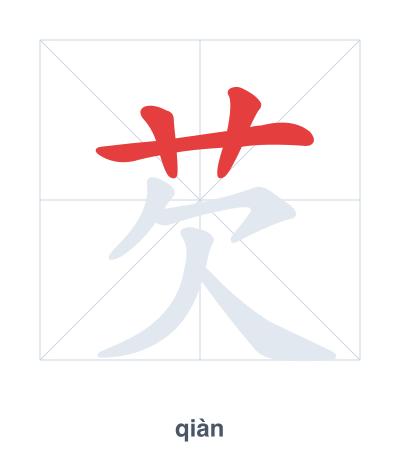
Open Hanzi Writer to see the animated stroke order and practice writing 芡 with real-time feedback.
The character 芡 (qiàn) is written with 7 strokes. Follow the standard Chinese stroke order: top to bottom, left to right, outside before inside. The radical 艹 is one of its key components.
Practice the correct stroke order with the Hanzi Writer app to see animated stroke-by-stroke guidance with real-time feedback.
芡 means Gorgon fruit / Euryale ferox.
芡 is a phono-semantic compound: the 艹 (grass) radical indicates it's a plant, while 欠 (qiàn, 'yawn/lack') gives the sound. Gorgon fruit is an aquatic plant with large leaves and spiny seed pods, so the 'grass' radical visually categorizes it as vegetation.
💡 Memory Tip: Picture a hungry man (欠) under the grass (艹) yawning while waiting for the spiky Gorgon fruit to open.
做菜时加一点芡粉。
zuò cài shí jiā yì diǎn qiàn fěn
Add a little starch when cooking.
这道菜需要勾芡。
zhè dào cài xū yào gōu qiàn
This dish needs to be thickened with a starch slurry.
芡实可以用来煮粥。
qiàn shí kě yǐ yòng lái zhǔ zhōu
Gorgon fruit can be used to cook porridge.
Open Hanzi Writer to see the animated stroke order and practice writing 芡 with real-time feedback.
✨ Animated stroke order · Handwriting recognition · HSK-graded practice · Free to use
芡 is composed of the grass radical 艹 on top and 欠 (qiàn) below. The grass radical shows it is a plant, while 欠 provides the pronunciation. Together they represent the gorgon fruit, an aquatic plant.