芪 (qí) means "Astragalus (medicinal root)" in Chinese. It has 7 strokes with the radical 艹.
Rated 3.5/5 in difficulty (challenging).
Appears in 3+ common words including 黄芪 (huáng qí), 芪草 (qí cǎo), 芪参 (qí cān).
Due to its 7 strokes, Hanzi Writer's error detection shows 芪 requires focused practice — most learners need 10+ attempts for consistent accuracy.
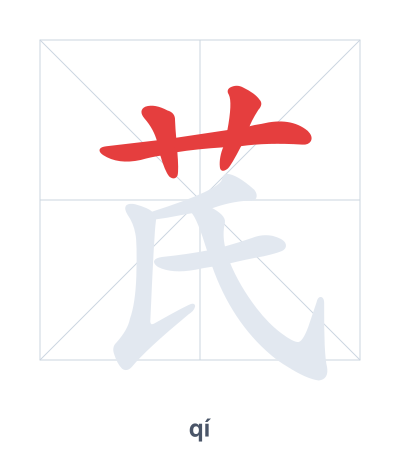
Open Hanzi Writer to see the animated stroke order and practice writing 芪 with real-time feedback.
The character 芪 (qí) is written with 7 strokes. Follow the standard Chinese stroke order: top to bottom, left to right, outside before inside. The radical 艹 is one of its key components.
Practice the correct stroke order with the Hanzi Writer app to see animated stroke-by-stroke guidance with real-time feedback.
芪 means Astragalus (medicinal root).
芪 is a phono-semantic compound. The radical 艹 (grass) indicates it is a plant, while 氏 (clan, pronounced shì) provides the phonetic hint for qí. Together, they signify the medicinal herb astragalus, a root used in traditional Chinese medicine.
💡 Memory Tip: Picture a clan member (氏) digging under the grass (艹) to harvest valuable astragalus roots.
喝点黄芪水很好。
hē diǎn huáng qí shuǐ hěn hǎo
Drinking some astragalus water is very good.
这种草叫芪草。
zhè zhòng cǎo jiào qí cǎo
This grass is called Astragalus.
芪参是中药。
qí cān shì zhōng yào
Astragalus and ginseng are Chinese medicines.
Open Hanzi Writer to see the animated stroke order and practice writing 芪 with real-time feedback.
✨ Animated stroke order · Handwriting recognition · HSK-graded practice · Free to use
芪 is composed of the grass radical 艹 on top, which indicates it is a plant, and 氏 below, which gives the sound "qí" in this context. Together, they form the name for astragalus, a medicinal herb.