伾 (pī) means "mighty; numerous (used in names)" in Chinese. It has 7 strokes with the radical 亻.
Rated 3.2/5 in difficulty (challenging).
Appears in 3+ common words including 伾伾 (pī pī), 伾山 (pī shān), 大伾 (dà pī).
Due to its 7 strokes, Hanzi Writer's error detection shows 伾 requires focused practice — most learners need 10+ attempts for consistent accuracy.
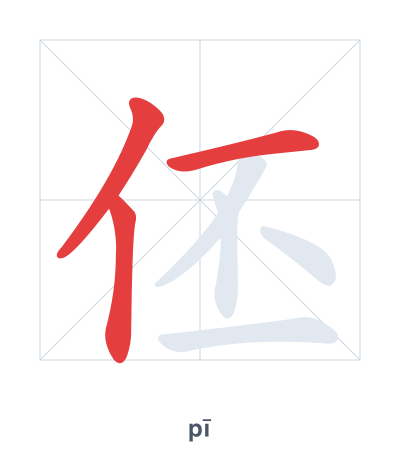
Open Hanzi Writer to see the animated stroke order and practice writing 伾 with real-time feedback.
The character 伾 (pī) is written with 7 strokes. Follow the standard Chinese stroke order: top to bottom, left to right, outside before inside. The radical 亻 is one of its key components.
Practice the correct stroke order with the Hanzi Writer app to see animated stroke-by-stroke guidance with real-time feedback.
伾 means mighty; numerous (used in names).
伾 combines the radical 亻 (person) with 丕 (pī, meaning 'great' or 'large'). The component 丕 itself depicts a large pedestal or foundation, suggesting size and magnitude. Together, the character originally conveyed a person of great stature or a multitude of people, hence 'mighty' or 'numerous.'
💡 Memory Tip: Imagine a person (亻) standing on a huge pedestal (丕), looking incredibly mighty and towering over everyone.
众车伾伾。
zhòng chē pī pī
Many carriages are moving powerfully.
伾山在河南。
pī shān zài hé nán
Mount Pi is in Henan.
大伾山很有名。
dà pī shān hěn yǒu míng
Mount Dapi is very famous.
Open Hanzi Writer to see the animated stroke order and practice writing 伾 with real-time feedback.
✨ Animated stroke order · Handwriting recognition · HSK-graded practice · Free to use
伾 is composed of the radical 亻 (person) on the left and 丕 (pī, meaning "great" or "large") on the right. The radical suggests a person, while 丕 adds the idea of largeness, together implying "mighty" or "numerous". This structure directly supports the meaning of strength or abundance associated with people.