钔 (mén) means "Mendelevium" in Chinese. It has 8 strokes with the radical 钅.
Rated 3.7/5 in difficulty (challenging).
Appears in 3+ common words including 钔元素 (mén yuán sù), 钔原子 (mén yuán zi), 金属钔 (jīn shǔ mén).
Due to its 8 strokes, Hanzi Writer's error detection shows 钔 requires focused practice — most learners need 10+ attempts for consistent accuracy.
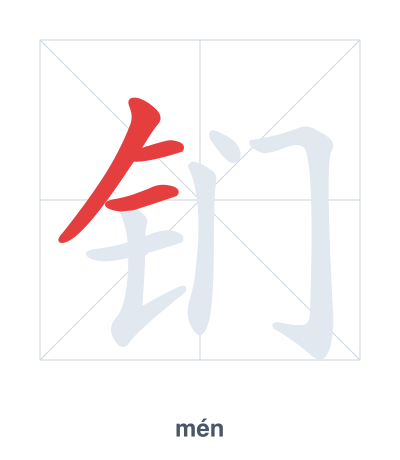
Open Hanzi Writer to see the animated stroke order and practice writing 钔 with real-time feedback.
The character 钔 (mén) is written with 8 strokes. Follow the standard Chinese stroke order: top to bottom, left to right, outside before inside. The radical 钅 is one of its key components.
Practice the correct stroke order with the Hanzi Writer app to see animated stroke-by-stroke guidance with real-time feedback.
钔 means Mendelevium.
钔 is a compound character combining the radical 钅 (metal) and the phonetic component 门 (door, pronounced mén). It follows the standard pattern for naming chemical elements, using the metal radical to indicate a metallic element and the phonetic to suggest the pronunciation 'mén', representing Mendelevium.
💡 Memory Tip: Picture a heavy metal door (钅+门) guarding the secret laboratory where Mendelevium was first created.
钔是以门捷列夫命名的。
mén shì yǐ mén jié liè fū mìng míng de
Mendelevium is named after Mendeleev.
钔原子的结构很复杂。
mén yuán zi de jié gòu hěn fù zá
The structure of a mendelevium atom is very complex.
实验室里有少量的钔。
shí yàn shì lǐ yǒu shǎo liàng de mén
There is a small amount of mendelevium in the laboratory.
Open Hanzi Writer to see the animated stroke order and practice writing 钔 with real-time feedback.
✨ Animated stroke order · Handwriting recognition · HSK-graded practice · Free to use
钔 is made of the radical 钅 (jīn, meaning metal or gold) on the left, and 门 (mén, meaning door) on the right. The radical indicates this character is a metal element, and the right side provides the pronunciation "mén." Together, they create the name for the synthetic radioactive metal Mendelevium.