炕 (kàng) means "Kang (heatable brick bed)" in Chinese. It has 8 strokes with the radical 火.
Rated 3.7/5 in difficulty (challenging).
Appears in 3+ common words including 火炕 (huǒ kàng), 炕头 (kàng tóu), 暖炕 (nuǎn kàng).
Due to its 8 strokes, Hanzi Writer's error detection shows 炕 requires focused practice — most learners need 10+ attempts for consistent accuracy.
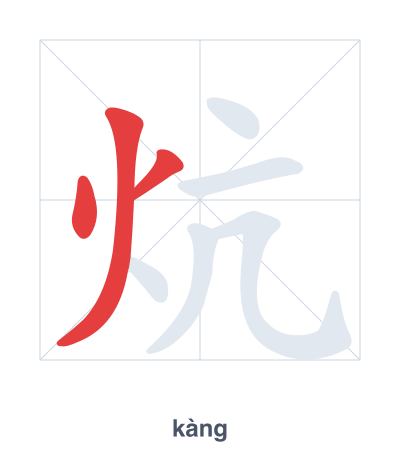
Open Hanzi Writer to see the animated stroke order and practice writing 炕 with real-time feedback.
The character 炕 (kàng) is written with 8 strokes. Follow the standard Chinese stroke order: top to bottom, left to right, outside before inside. The radical 火 is one of its key components.
Practice the correct stroke order with the Hanzi Writer app to see animated stroke-by-stroke guidance with real-time feedback.
炕 means Kang (heatable brick bed).
炕 combines the fire radical (火) with 亢 (kàng), which originally meant 'high' or 'raised' and also provides the sound. Together, they depict a raised brick platform heated by fire underneath—the traditional Chinese kang bed.
💡 Memory Tip: Picture a blazing fire (火) directly below a tall, raised brick platform (亢 shape) warming it into a cozy sleeping bed.
炕上很暖和。
kàng shàng hěn nuǎn huo
It is very warm on the kang bed.
坐在炕头聊天。
zuò zài kàng tóu liáo tiān
Sitting on the edge of the heated brick bed chatting.
暖炕很舒服。
nuǎn kàng hěn shū fú
The heated brick bed is very comfortable.
Open Hanzi Writer to see the animated stroke order and practice writing 炕 with real-time feedback.
✨ Animated stroke order · Handwriting recognition · HSK-graded practice · Free to use
炕 is made of two parts: the left radical 火 (fire) and the right part 亢 (kàng, which gives the sound). The fire radical shows that this bed is heated by fire, so the whole character means a heatable brick bed (kang).