Hanzi Writer

How to Write 烬 (jìn) — Meaning “Ashes or cinders”

jìn 10 strokes Radical: 火

烬 (jìn) means "Ashes or cinders" in Chinese. It has 10 strokes with the radical 火.

Rated 4.2/5 in difficulty (advanced).

Appears in 3+ common words including 灰烬 (huī jìn), 余烬 (yú jìn), 化为灰烬 (huà wéi huī jìn).

Due to its 10 strokes, Hanzi Writer's error detection shows 烬 requires focused practice — most learners need 10+ attempts for consistent accuracy.
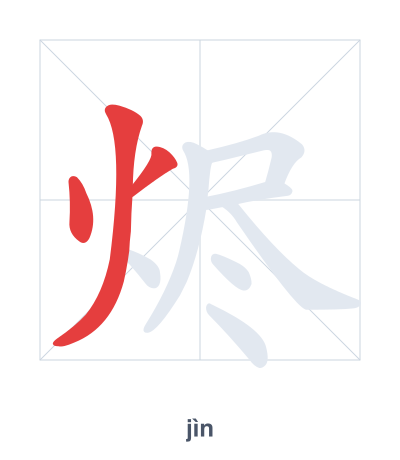
Stroke order practice for 烬 - jìn

Practice Writing 烬 (jìn)

Open Hanzi Writer to see the animated stroke order and practice writing 烬 with real-time feedback.

The character (jìn) is written with 10 strokes. Follow the standard Chinese stroke order: top to bottom, left to right, outside before inside. The radical is one of its key components.

Practice the correct stroke order with the Hanzi Writer app to see animated stroke-by-stroke guidance with real-time feedback.

means Ashes or cinders.

Character
Pinyinjìn (jin)
MeaningAshes or cinders
Strokes10
Radical
Difficulty4.2/5

烬 is a compound character with the radical 火 (fire) and the phonetic-sound component 尽 (jìn, meaning 'exhausted' or 'finished'). The combination suggests fire that has completely burned out, leaving only ashes or cinders behind.

💡 Memory Tip: Picture a fire (火) that has fully burned down (尽), leaving nothing but gray ashes scattered on the ground.

huī jìn
ashes; cinders
yú jìn
embers
huà wéi huī jìn
to turn to ashes

纸变成了灰烬。

zhǐ biàn chéng le huī jìn

The paper turned into ashes.

火堆里还有余烬。

huǒ duī lǐ hái yǒu yú jìn

There are still embers in the bonfire.

房子化为灰烬。

fáng zi huà wéi huī jìn

The house was reduced to ashes.

Character Pinyin Strokes Radical
(current) jìn 10
jiǒng 8
wén 8
8
Stroke order practice for 烬 - jìn

Practice Writing 烬 (jìn)

Open Hanzi Writer to see the animated stroke order and practice writing 烬 with real-time feedback.

✨ Animated stroke order · Handwriting recognition · HSK-graded practice · Free to use

Frequently Asked Questions about 烬

烬 combines the radical 火 (fire) on the left with the phonetic component 尽 (jìn, meaning 'to exhaust') on the right. The fire radical suggests something burned, while 尽 implies the fire has completely finished, leaving only ashes or cinders.

Characters with Radical 火

Other 10-Stroke Characters