砩 (fú) means "Fluorine (old term) / To obstruct" in Chinese. It has 10 strokes with the radical 石.
Rated 4.2/5 in difficulty (advanced).
Appears in 3+ common words including 砩石 (fú shí), 砩粉 (fú fěn), 砩矿 (fú kuàng).
Due to its 10 strokes, Hanzi Writer's error detection shows 砩 requires focused practice — most learners need 10+ attempts for consistent accuracy.
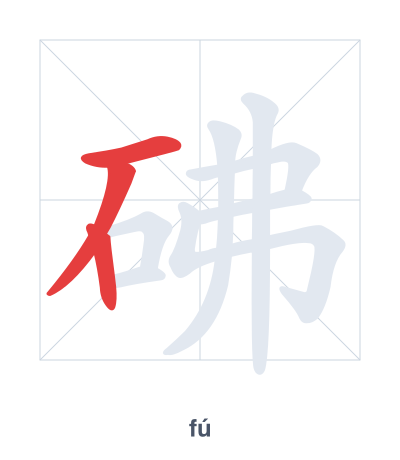
Open Hanzi Writer to see the animated stroke order and practice writing 砩 with real-time feedback.
The character 砩 (fú) is written with 10 strokes. Follow the standard Chinese stroke order: top to bottom, left to right, outside before inside. The radical 石 is one of its key components.
Practice the correct stroke order with the Hanzi Writer app to see animated stroke-by-stroke guidance with real-time feedback.
砩 means Fluorine (old term) / To obstruct.
砩 combines the radical 石 (stone/mineral) with 弗 (fú, meaning 'not' or 'to stop'), indicating a mineral substance that can obstruct or block—historically used for fluorine, a reactive element often found in mineral compounds.
💡 Memory Tip: Imagine a stone (石) saying 'No!' (弗) to a river, blocking its flow like a fluorite dam.
这里发现了一块砩石。
zhè lǐ fā xiàn le yī kuài fú shí
A piece of fluorite was discovered here.
这种砩粉很有用。
zhè zhǒng fú fěn hěn yǒu yòng
This fluorite powder is very useful.
这是一个砩矿场。
zhè shì yí gè fú kuàng chǎng
This is a fluorite mine.
Open Hanzi Writer to see the animated stroke order and practice writing 砩 with real-time feedback.
✨ Animated stroke order · Handwriting recognition · HSK-graded practice · Free to use
砩 is made of the radical 石 (stone) on the left and 弗 on the right. The stone radical connects to minerals like fluorite, a type of stone. The right part 弗 provides the pronunciation fú and does not directly contribute to the mineral meaning.