扼 (è) means "to clutch; to grip; to guard" in Chinese. It has 7 strokes with the radical 扌.
Rated 3.5/5 in difficulty (challenging).
Appears in 3+ common words including 扼要 (è yào), 扼杀 (è shā), 扼守 (è shǒu).
Due to its 7 strokes, Hanzi Writer's error detection shows 扼 requires focused practice — most learners need 10+ attempts for consistent accuracy.
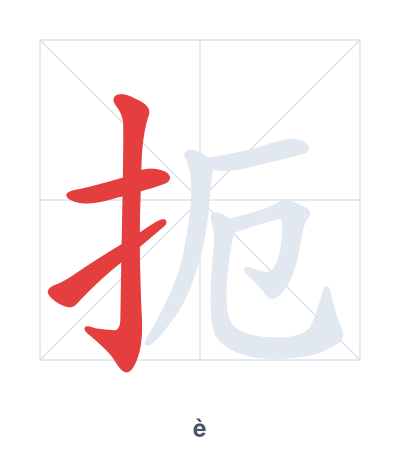
Open Hanzi Writer to see the animated stroke order and practice writing 扼 with real-time feedback.
The character 扼 (è) is written with 7 strokes. Follow the standard Chinese stroke order: top to bottom, left to right, outside before inside. The radical 扌 is one of its key components.
Practice the correct stroke order with the Hanzi Writer app to see animated stroke-by-stroke guidance with real-time feedback.
扼 means to clutch; to grip; to guard.
扼 is a phono-semantic compound. The left side 扌 (hand) indicates an action, while the right side 厄 (è) originally meant 'dangerous pass' and provides the sound; together they convey the idea of gripping or clutching something tightly, as if to guard a critical point.
💡 Memory Tip: Imagine a hand (扌) clamping down on a snake (厄 looks like a snake head) to stop it from striking—a firm, guarding grip.
他的话简明扼要。
tā de huà jiǎn míng è yào
His words were concise and to the point.
别扼杀他的好奇心。
bié è shā tā de hào qí xīn
Don't stifle his curiosity.
军队扼守着大桥。
jūn duì è shǒu zhe dà qiáo
The army is guarding the bridge.
Open Hanzi Writer to see the animated stroke order and practice writing 扼 with real-time feedback.
✨ Animated stroke order · Handwriting recognition · HSK-graded practice · Free to use
扼 is made of the hand radical 扌 on the left and the component 厄 on the right. The hand radical suggests an action done with the hand, while 厄 means a narrow or difficult place. Together they imply using your hand to grip something tightly or guard a strategic point.