邸 (dǐ) means "official residence; mansion" in Chinese. It has 7 strokes with the radical 阝.
Rated 3.2/5 in difficulty (challenging).
Appears in 3+ common words including 官邸 (guān dǐ), 邸报 (dǐ bào), 府邸 (fǔ dǐ).
Due to its 7 strokes, Hanzi Writer's error detection shows 邸 requires focused practice — most learners need 10+ attempts for consistent accuracy.
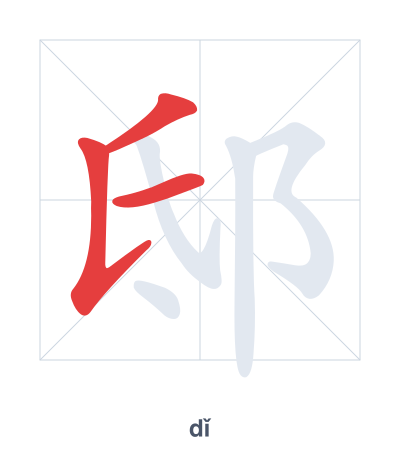
Open Hanzi Writer to see the animated stroke order and practice writing 邸 with real-time feedback.
The character 邸 (dǐ) is written with 7 strokes. Follow the standard Chinese stroke order: top to bottom, left to right, outside before inside. The radical 阝 is one of its key components.
Practice the correct stroke order with the Hanzi Writer app to see animated stroke-by-stroke guidance with real-time feedback.
邸 means official residence; mansion.
邸 combines the radical 阝 (left, meaning city or town) with 氐 (dǐ, meaning base or foundation). The compound suggests a 'foundation in the town'—an official's residence or mansion located at a central base.
💡 Memory Tip: Imagine a town (阝) where a grand mansion sits on a low, wide base (氐), with the left stroke of 阝 forming the wall and 氐 the sloped roof.
这是总统的官邸。
zhè shì zǒng tǒng de guān dǐ
This is the president's official residence.
古代的人看邸报。
gǔ dài de rén kàn dǐ bào
Ancient people read the official gazette.
这座府邸非常大。
zhè zuò fǔ dǐ fēi cháng dà
This mansion is very large.
Open Hanzi Writer to see the animated stroke order and practice writing 邸 with real-time feedback.
✨ Animated stroke order · Handwriting recognition · HSK-graded practice · Free to use
邸 is made of the left radical 阝 (meaning 'mound' or 'place') and the right part 氐 (which gives the sound dǐ). The radical hints that the character refers to a location, and combined with 氐, it creates the idea of a base or foundation for a residence. This structure leads to the meaning of an official residence or mansion.