枞 (cōng/zōng) means "fir tree" in Chinese. It has 8 strokes with the radical 木.
Rated 3.7/5 in difficulty (challenging).
Appears in 3+ common words including 枞树 (cōng shù), 枞木 (cōng mù), 枞阳 (zōng yáng).
Due to its 8 strokes, Hanzi Writer's error detection shows 枞 requires focused practice — most learners need 10+ attempts for consistent accuracy.
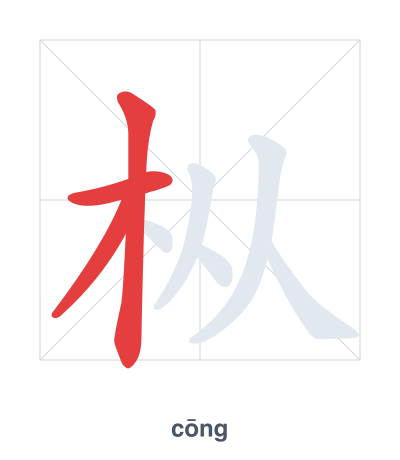
Open Hanzi Writer to see the animated stroke order and practice writing 枞 with real-time feedback.
The character 枞 (cōng/zōng) is written with 8 strokes. Follow the standard Chinese stroke order: top to bottom, left to right, outside before inside. The radical 木 is one of its key components.
Practice the correct stroke order with the Hanzi Writer app to see animated stroke-by-stroke guidance with real-time feedback.
枞 means fir tree.
This is a polyphonic character with readings: cōng, zōng.
枞 is a phono-semantic compound: the radical 木 (tree) indicates it's a type of tree, while 从 (cóng, 'to follow' or 'together') provides the sound and hints that fir trees often grow in dense clusters, following one another.
💡 Memory Tip: Two people (从) stand side by side under a tall tree (木), taking a rest in the shade of a fir.
这里的枞树很高。
zhè lǐ de cōng shù hěn gāo
The fir trees here are very tall.
这张桌子是枞木做的。
zhè zhāng zhuō zi shì cōng mù zuò de
This table is made of fir wood.
他出生在枞阳。
tā chū shēng zài zōng yáng
He was born in Zongyang.
Open Hanzi Writer to see the animated stroke order and practice writing 枞 with real-time feedback.
✨ Animated stroke order · Handwriting recognition · HSK-graded practice · Free to use
The character 枞 is made of two parts: the left side is 木 (mù), meaning 'tree' or 'wood,' and the right side is 从 (cóng), which gives the sound cōng. Together, 木 shows the category (a type of tree), and 从 provides the pronunciation, so 枞 means 'fir tree.'