坌 (bèn) means "Dust / To gather" in Chinese. It has 7 strokes with the radical 土.
Rated 3.5/5 in difficulty (challenging).
Appears in 3+ common words including 坌土 (bèn tǔ), 坌集 (bèn jí), 坌息 (bèn xī).
Due to its 7 strokes, Hanzi Writer's error detection shows 坌 requires focused practice — most learners need 10+ attempts for consistent accuracy.
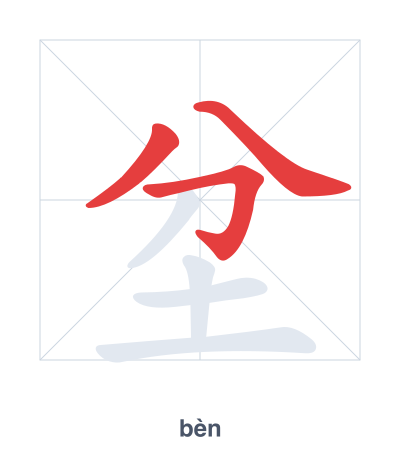
Open Hanzi Writer to see the animated stroke order and practice writing 坌 with real-time feedback.
The character 坌 (bèn) is written with 7 strokes. Follow the standard Chinese stroke order: top to bottom, left to right, outside before inside. The radical 土 is one of its key components.
Practice the correct stroke order with the Hanzi Writer app to see animated stroke-by-stroke guidance with real-time feedback.
坌 means Dust / To gather.
坌 is a compound character with 分 (divide) above 土 (earth). The combination suggests earth that has been broken into fine particles, hence 'dust.' The meaning 'to gather' may come from dust settling or collecting together.
💡 Memory Tip: Picture a pile of dust (土) that someone splits (分) into two heaps, only for it to gather back together again.
地上有不少坌土。
dì shàng yǒu bù shǎo bèn tǔ
There is quite a lot of dust on the ground.
许多人坌集在一起。
xǔ duō rén bèn jí zài yì qǐ
Many people gathered together.
空气中充满了坌息。
kōng qì zhōng chōng mǎn le bèn xī
The air is filled with dust.
Open Hanzi Writer to see the animated stroke order and practice writing 坌 with real-time feedback.
✨ Animated stroke order · Handwriting recognition · HSK-graded practice · Free to use
坌 combines 土 (earth) on top and 分 (divide) on the bottom. The earth radical suggests dirt or soil, while 分 implies scattering or separating, together evoking the idea of dust that is scattered or gathered loose earth.