鼹 (yǎn) means "Mole (animal)" in Chinese. It has 23 strokes with the radical 鼠.
Rated 4.2/5 in difficulty (advanced).
Appears in 3+ common words including 鼹鼠 (yǎn shǔ), 鼹洞 (yǎn dòng), 鼹皮 (yǎn pí).
Due to its 23 strokes, Hanzi Writer's error detection shows 鼹 requires focused practice — most learners need 10+ attempts for consistent accuracy.
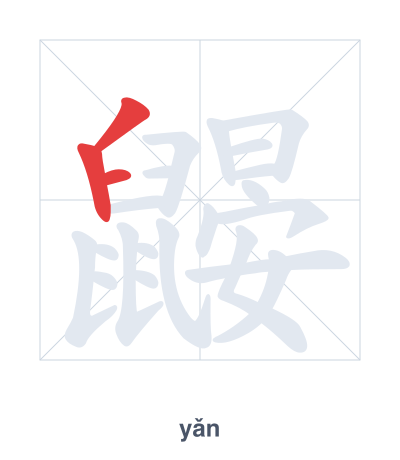
Open Hanzi Writer to see the animated stroke order and practice writing 鼹 with real-time feedback.
The character 鼹 (yǎn) is written with 23 strokes. Follow the standard Chinese stroke order: top to bottom, left to right, outside before inside. The radical 鼠 is one of its key components.
Practice the correct stroke order with the Hanzi Writer app to see animated stroke-by-stroke guidance with real-time feedback.
鼹 means Mole (animal).
| Character | 鼹 |
| Pinyin | yǎn (yan) |
| Meaning | Mole (animal) |
| Strokes | 23 |
| Radical | 鼠 |
| Difficulty | 4.2/5 |
The character 鼹 combines the radical 鼠 (rat/mouse), indicating it is a rodent, with the phonetic component 晏 (yàn, meaning 'peaceful' or 'late'). This reflects the mole as a burrowing rodent that lives quietly underground. The ancient form of 鼠 depicted a rat with a long tail and claws, which evolved into the modern radical.
💡 Memory Tip: Imagine a mole (鼠) digging so peacefully (晏) that it naps under the sun (日) on a safe mound (安).
鼹鼠不喜欢阳光。
yǎn shǔ bù xǐ huān yáng guāng
Moles do not like sunlight.
地上有一个鼹洞。
dì shàng yǒu yí gè yǎn dòng
There is a mole hole on the ground.
鼹皮可以做手套。
yǎn pí kě yǐ zuò shǒu tào
Moleskin can be used to make gloves.
Open Hanzi Writer to see the animated stroke order and practice writing 鼹 with real-time feedback.
✨ Animated stroke order · Handwriting recognition · HSK-graded practice · Free to use
The left component is 鼠 (shǔ), the radical for rat or rodent, indicating this character is a type of rodent. The right component is 匽 (yǎn), which means to hide or conceal, reflecting the mole's habit of living underground.