宛 (wǎn) means "As if / Winding" in Chinese. It has 8 strokes with the radical 宀.
Rated 3.7/5 in difficulty (challenging).
Appears in 3+ common words including 宛如 (wǎn rú), 宛转 (wǎn zhuǎn), 宛若 (wǎn ruò).
Due to its 8 strokes, Hanzi Writer's error detection shows 宛 requires focused practice — most learners need 10+ attempts for consistent accuracy.
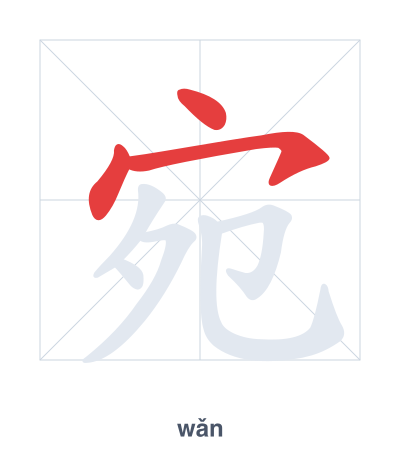
Open Hanzi Writer to see the animated stroke order and practice writing 宛 with real-time feedback.
The character 宛 (wǎn) is written with 8 strokes. Follow the standard Chinese stroke order: top to bottom, left to right, outside before inside. The radical 宀 is one of its key components.
Practice the correct stroke order with the Hanzi Writer app to see animated stroke-by-stroke guidance with real-time feedback.
宛 means As if / Winding.
The character 宛 combines a roof (宀) with 夗, which originally depicted a person curling up or bending. Together, they evoke the image of something winding or bending under cover, giving the meanings 'as if' (something that appears to be) and 'winding' (twisting like a path).
💡 Memory Tip: Picture a curled snake under a roof (宀) — it looks 'as if' it's sleeping, but it's actually winding its body.
这里宛如仙境。
zhè lǐ wǎn rú xiān jìng
This place is like a fairyland.
歌声很宛转。
gē shēng hěn wǎn zhuǎn
The singing is very melodious.
她宛若一位天使。
tā wǎn ruò yī wèi tiān shǐ
She is just like an angel.
Open Hanzi Writer to see the animated stroke order and practice writing 宛 with real-time feedback.
✨ Animated stroke order · Handwriting recognition · HSK-graded practice · Free to use
The character 宛 combines the radical 宀 (roof) on top, suggesting a house or covering, with 夕 (evening) below. The roof may imply a winding path under a shelter, while the evening component hints at a softened or indirect quality, fitting meanings like "as if" or "winding."