鼍 (tuó) means "Chinese alligator" in Chinese. It has 20 strokes with the radical 黾.
Rated 3.8/5 in difficulty (challenging).
Appears in 3+ common words including 扬子鼍 (yáng zi tuó), 鼍鼓 (tuó gǔ), 鼍皮 (tuó pí).
Due to its 20 strokes, Hanzi Writer's error detection shows 鼍 requires focused practice — most learners need 10+ attempts for consistent accuracy.
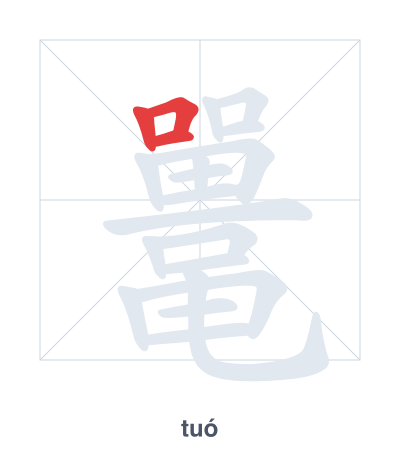
Open Hanzi Writer to see the animated stroke order and practice writing 鼍 with real-time feedback.
The character 鼍 (tuó) is written with 20 strokes. Follow the standard Chinese stroke order: top to bottom, left to right, outside before inside. The radical 黾 is one of its key components.
Practice the correct stroke order with the Hanzi Writer app to see animated stroke-by-stroke guidance with real-time feedback.
鼍 means Chinese alligator.
| Character | 鼍 |
| Pinyin | tuó (tuo) |
| Meaning | Chinese alligator |
| Strokes | 20 |
| Radical | 黾 |
| Difficulty | 3.8/5 |
鼍 is a compound character; the lower part 黾 depicts a reptile (originally a frog or toad), indicating the animal class. The upper part combines 田 (field), a horizontal line, and 口 (mouth), which together evoke the broad, flat head and snout of a Chinese alligator.
💡 Memory Tip: Imagine a reptile (黾) with a square field (田) on top, and a big mouth (口) sticking out – that's the Chinese alligator lurking by the water.
这是扬子鼍。
zhè shì yáng zi tuó
This is a Yangtze alligator.
他在敲鼍鼓。
tā zài qiāo tuó gǔ
He is beating an alligator-skin drum.
这是一个鼍皮包。
zhè shì yí gè tuó pí bāo
This is an alligator skin bag.
Open Hanzi Writer to see the animated stroke order and practice writing 鼍 with real-time feedback.
✨ Animated stroke order · Handwriting recognition · HSK-graded practice · Free to use
The character 鼍 consists of the radical 黾, which represents a reptile or frog, and the phonetic component 单 (dān). The radical 黾 links the character to reptiles, specifically the Chinese alligator, while 单 hints at the pronunciation "tuó."