抟 (tuán) means "to roll into a ball with hands; to knead" in Chinese. It has 7 strokes with the radical 扌.
Rated 3.5/5 in difficulty (challenging).
Appears in 3+ common words including 抟弄 (tuán nòng), 抟聚 (tuán jù), 抟成 (tuán chéng).
Due to its 7 strokes, Hanzi Writer's error detection shows 抟 requires focused practice — most learners need 10+ attempts for consistent accuracy.
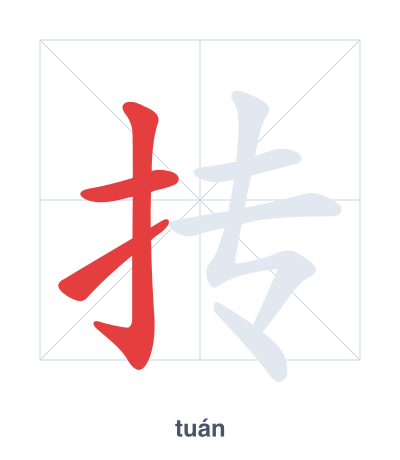
Open Hanzi Writer to see the animated stroke order and practice writing 抟 with real-time feedback.
The character 抟 (tuán) is written with 7 strokes. Follow the standard Chinese stroke order: top to bottom, left to right, outside before inside. The radical 扌 is one of its key components.
Practice the correct stroke order with the Hanzi Writer app to see animated stroke-by-stroke guidance with real-time feedback.
抟 means to roll into a ball with hands; to knead.
The character 抟 combines the hand radical 扌 with 专, which originally depicted a spindle used for rolling thread. Together, they represent the hand action of rolling or kneading something into a ball shape.
💡 Memory Tip: Picture your hand (扌) spinning a spindle (专) to roll dough into a perfect ball.
他在手里抟弄泥土。
tā zài shǒu lǐ tuán nòng ní tǔ
He is kneading the clay in his hands.
乌云在空中抟聚。
wū yún zài kōng zhōng tuán jù
Dark clouds are gathering in the sky.
把面粉抟成球。
bǎ miàn fěn tuán chéng qiú
Roll the flour into a ball.
Open Hanzi Writer to see the animated stroke order and practice writing 抟 with real-time feedback.
✨ Animated stroke order · Handwriting recognition · HSK-graded practice · Free to use
抟 is composed of the radical 扌 (hand) on the left and 专 (zhuān) on the right. The hand radical directly indicates the action of using hands, while 专 provides pronunciation and is unrelated to meaning. Together, the structure suggests using your hands to roll or knead something into a ball.