芟 (shān) means "To mow / To cut down grass" in Chinese. It has 7 strokes with the radical 艹.
Rated 3.5/5 in difficulty (challenging).
Appears in 3+ common words including 芟除 (shān chú), 芟草 (shān cǎo), 芟刈 (shān yì).
Due to its 7 strokes, Hanzi Writer's error detection shows 芟 requires focused practice — most learners need 10+ attempts for consistent accuracy.
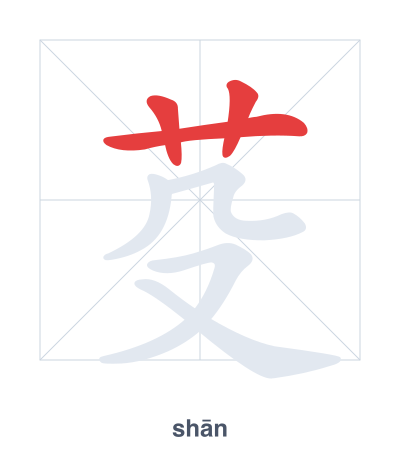
Open Hanzi Writer to see the animated stroke order and practice writing 芟 with real-time feedback.
The character 芟 (shān) is written with 7 strokes. Follow the standard Chinese stroke order: top to bottom, left to right, outside before inside. The radical 艹 is one of its key components.
Practice the correct stroke order with the Hanzi Writer app to see animated stroke-by-stroke guidance with real-time feedback.
芟 means To mow / To cut down grass.
芟 combines the grass radical 艹 with 殳, which depicts a hand holding a weapon or tool, together representing the action of cutting down grass with a scythe.
💡 Memory Tip: Picture a scythe (殳) slicing through a patch of grass (艹) to mow it down.
我们要芟除园中的杂草。
wǒ men yào shān chú yuán zhōng de zá cǎo
We need to mow the weeds in the garden.
他在田里忙着芟草。
tā zài tián lǐ máng zhe shān cǎo
He is busy mowing weeds in the field.
农民在芟刈庄稼。
nóng mín zài shān yì zhuāng jià
Farmers are reaping the crops.
Open Hanzi Writer to see the animated stroke order and practice writing 芟 with real-time feedback.
✨ Animated stroke order · Handwriting recognition · HSK-graded practice · Free to use
芟 is composed of the grass radical 艹 on top and 殳 below. The radical 艹 indicates the character is related to grass or plants, while 殳 represents a hand holding a weapon or tool. Together they show the action of cutting down grass with a tool.