苈 (lì) means "Draba (a genus of flowering plants)" in Chinese. It has 7 strokes with the radical 艹.
Rated 3.5/5 in difficulty (challenging).
Appears in 3+ common words including 葶苈 (tíng lì), 葶苈子 (tíng lì zi), 苦葶苈 (kǔ tíng lì).
Due to its 7 strokes, Hanzi Writer's error detection shows 苈 requires focused practice — most learners need 10+ attempts for consistent accuracy.
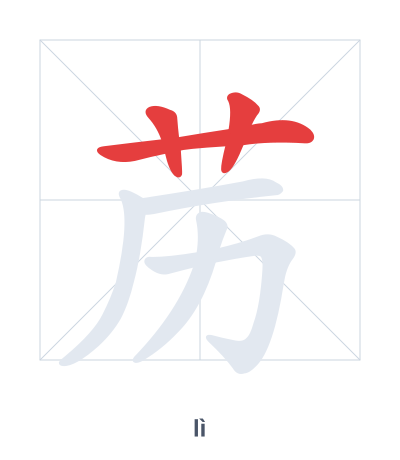
Open Hanzi Writer to see the animated stroke order and practice writing 苈 with real-time feedback.
The character 苈 (lì) is written with 7 strokes. Follow the standard Chinese stroke order: top to bottom, left to right, outside before inside. The radical 艹 is one of its key components.
Practice the correct stroke order with the Hanzi Writer app to see animated stroke-by-stroke guidance with real-time feedback.
苈 means Draba (a genus of flowering plants).
苈 is a phono-semantic compound: the radical 艹 indicates it's a plant, while 历 (lì) provides the pronunciation and originally means 'to pass through' or 'calendar.' This small, low-growing herb was named for its quick life cycle, passing through seasons swiftly like a calendar turning pages.
💡 Memory Tip: Picture a grass plant (艹) whose leaves are so tiny they look like calendar numbers (历), reminding you it's the quick-flowering draba.
葶苈是一种植物。
tíng lì shì yī zhǒng zhí wù
Draba is a type of plant.
葶苈子可以入药。
tíng lì zi kě yǐ rù yào
Draba seeds can be used as medicine.
苦葶苈的味道苦。
kǔ tíng lì de wèi dào kǔ
Bitter tansy mustard tastes bitter.
Open Hanzi Writer to see the animated stroke order and practice writing 苈 with real-time feedback.
✨ Animated stroke order · Handwriting recognition · HSK-graded practice · Free to use
苈 is made of the grass radical 艹 on top and the phonetic component 历 (lì) below. The grass radical shows it is a type of plant, and 历 gives the pronunciation, though its original meaning of "calendar" does not relate to the plant's meaning.