芰 (jì) means "Water chestnut / Water caltrop" in Chinese. It has 7 strokes with the radical 艹.
Rated 3.5/5 in difficulty (challenging).
Appears in 3+ common words including 芰荷 (jì hé), 芰制 (jì zhì), 芰茄 (jì jiā).
Due to its 7 strokes, Hanzi Writer's error detection shows 芰 requires focused practice — most learners need 10+ attempts for consistent accuracy.
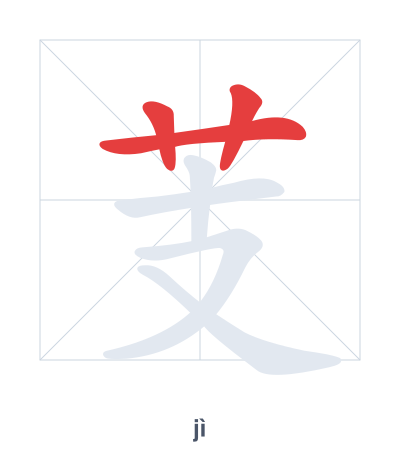
Open Hanzi Writer to see the animated stroke order and practice writing 芰 with real-time feedback.
The character 芰 (jì) is written with 7 strokes. Follow the standard Chinese stroke order: top to bottom, left to right, outside before inside. The radical 艹 is one of its key components.
Practice the correct stroke order with the Hanzi Writer app to see animated stroke-by-stroke guidance with real-time feedback.
芰 means Water chestnut / Water caltrop.
This character is a phono-semantic compound: the radical 艹 (grass/plant) indicates it is a type of plant, and the phonetic component 支 (zhī) approximates the sound. The ancient form depicted a water chestnut plant with its distinctive horned fruit, combining the plant radical with a phonetic element.
💡 Memory Tip: Imagine a water chestnut plant (艹) sending out a supporting branch (支) underwater to hold its spiky fruit.
池塘里有芰荷。
chí táng lǐ yǒu jì hé
There are water lilies and lotuses in the pond.
芰制是古老的衣服。
jì zhì shì gǔ lǎo de yī fú
Jizhi is an ancient type of clothing.
芰茄是一种植物。
jì jiā shì yī zhǒng zhí wù
Water caltrop is a type of plant.
Open Hanzi Writer to see the animated stroke order and practice writing 芰 with real-time feedback.
✨ Animated stroke order · Handwriting recognition · HSK-graded practice · Free to use
芰 is made of the radical 艹 (grass/plants) on top and 支 (branch) below. The grass radical shows it's a type of plant, while 支 hints at the plant's branching stems or leaves. Together they represent the water chestnut or water caltrop, an aquatic plant with branched leaves.