汩 (gǔ) means "Gurgle / flow" in Chinese. It has 7 strokes with the radical 氵.
Rated 3.5/5 in difficulty (challenging).
Appears in 3+ common words including 汩汩 (gǔ gǔ), 汩流 (gǔ liú), 汩没 (gǔ mò).
Due to its 7 strokes, Hanzi Writer's error detection shows 汩 requires focused practice — most learners need 10+ attempts for consistent accuracy.
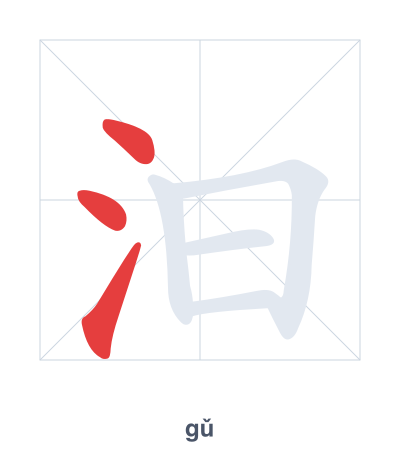
Open Hanzi Writer to see the animated stroke order and practice writing 汩 with real-time feedback.
The character 汩 (gǔ) is written with 7 strokes. Follow the standard Chinese stroke order: top to bottom, left to right, outside before inside. The radical 氵 is one of its key components.
Practice the correct stroke order with the Hanzi Writer app to see animated stroke-by-stroke guidance with real-time feedback.
汩 means Gurgle / flow.
The character 汩 combines the water radical 氵 with 曰 (to speak), suggesting water making speaking-like sounds—a metaphor for the gurgling or bubbling flow of a stream. Its ancient form is not a simple pictograph; it is a compound where the phonetic component 曰 (yue) likely also hints at the sound of rushing water.
💡 Memory Tip: Picture a mouth (曰) gurgling and splashing water (氵) as it babbles like a brook.
泉水汩汩地流着。
quán shuǐ gǔ gǔ dì liú zhe
The spring water is gurgling.
溪水在山间汩流。
xī shuǐ zài shān jiān gǔ liú
The stream gurgles through the mountains.
他的才华被汩没了。
tā de cái huá bèi gǔ mò le
His talent has been buried and forgotten.
Open Hanzi Writer to see the animated stroke order and practice writing 汩 with real-time feedback.
✨ Animated stroke order · Handwriting recognition · HSK-graded practice · Free to use
The left side is the radical 氵, meaning water, and the right side is 曰 (pronounced yuē), which originally represented a mouth speaking. Together, they suggest water making a gurgling sound as it flows, like water bubbling up from a spring.