芾 (fèi) means "Luxuriant foliage; small" in Chinese. It has 7 strokes with the radical 艹.
Rated 3.5/5 in difficulty (challenging).
Appears in 3+ common words including 蔽芾 (bì fèi), 芾芾 (fèi fèi), 芾子 (fèi zi).
Due to its 7 strokes, Hanzi Writer's error detection shows 芾 requires focused practice — most learners need 10+ attempts for consistent accuracy.
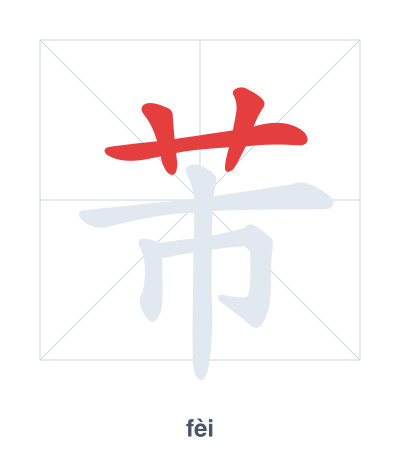
Open Hanzi Writer to see the animated stroke order and practice writing 芾 with real-time feedback.
The character 芾 (fèi) is written with 7 strokes. Follow the standard Chinese stroke order: top to bottom, left to right, outside before inside. The radical 艹 is one of its key components.
Practice the correct stroke order with the Hanzi Writer app to see animated stroke-by-stroke guidance with real-time feedback.
芾 means Luxuriant foliage; small.
芾 is a compound character formed by the grass radical 艹 on top and the phonetic component 巿 below. The grass radical connects it to plants and foliage, while the lower part originally depicted a knee-length garment, together suggesting a covering of lush, small leaves.
💡 Memory Tip: Imagine a tiny plant (艹) wearing a little dress (巿) to show off its luxuriant but small foliage.
蔽芾甘棠。
bì fèi gān táng
Lush is the sweet pear tree (classic poetic line).
这里的枝叶芾芾。
zhè lǐ de zhī yè fèi fèi
The foliage here is lush and luxuriant.
芾子是古书里的词。
fèi zi shì gǔ shū lǐ de cí
'Feizi' is a word found in ancient books.
Open Hanzi Writer to see the animated stroke order and practice writing 芾 with real-time feedback.
✨ Animated stroke order · Handwriting recognition · HSK-graded practice · Free to use
芾 is made of the grass radical 艹 on top, which indicates plants, and the component 巿 (fú) below. The top part suggests the meaning relates to foliage, while the bottom part provides a phonetic clue. Together they create the idea of "lush foliage" or "small plants."