汴 (biàn) means "Bian (ancient name for Kaifeng or a river)" in Chinese. It has 7 strokes with the radical 氵.
Rated 3.5/5 in difficulty (challenging).
Appears in 3+ common words including 汴京 (biàn jīng), 汴河 (biàn hé), 汴水 (biàn shuǐ).
Due to its 7 strokes, Hanzi Writer's error detection shows 汴 requires focused practice — most learners need 10+ attempts for consistent accuracy.
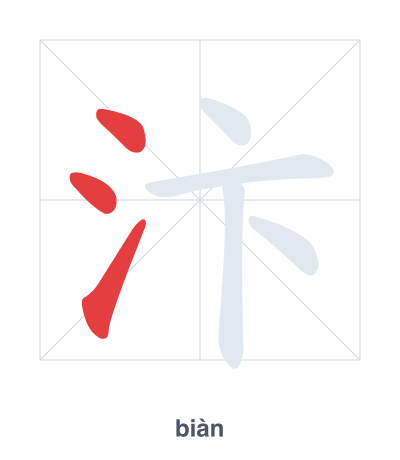
Open Hanzi Writer to see the animated stroke order and practice writing 汴 with real-time feedback.
The character 汴 (biàn) is written with 7 strokes. Follow the standard Chinese stroke order: top to bottom, left to right, outside before inside. The radical 氵 is one of its key components.
Practice the correct stroke order with the Hanzi Writer app to see animated stroke-by-stroke guidance with real-time feedback.
汴 means Bian (ancient name for Kaifeng or a river).
汴 is a phono-semantic compound. The left component 氵 (water radical) indicates it relates to a river, and the right part 卞 (biàn) provides the pronunciation. Historically, it referred to the Bian River (汴水) in ancient China, and later became the alternate name for the city of Kaifeng.
💡 Memory Tip: Picture a person (卞) with a tall hat standing by the water (氵), watching the Bian River flow past.
汴京是古代的都城。
biàn jīng shì gǔ dài de dū chéng
Bianjing was an ancient capital city.
汴河在河南境内。
biàn hé zài hé nán jìng nèi
The Bian River is within Henan Province.
汴水流过这座城市。
biàn shuǐ liú guò zhè zuò chéng shì
The Bian River flows through this city.
Open Hanzi Writer to see the animated stroke order and practice writing 汴 with real-time feedback.
✨ Animated stroke order · Handwriting recognition · HSK-graded practice · Free to use
The character 汴 (biàn) consists of the radical 氵 (water) on the left and the phonetic component 卞 (biàn) on the right. The water radical indicates that the character is related to a river or water, while 卞 provides the pronunciation. Together, they refer to the Bian River or the ancient name for Kaifeng, a city located near this river.