髫 (tiáo) signifie « Enfance (cheveux d'enfant) » en chinois. Il a 15 traits avec le radical 髟.
Noté 4.2/5 en difficulté (avancé).
Apparaît dans 3+ mots courants dont 垂髫 (chuí tiáo), 髫年 (tiáo nián), 髫龄 (tiáo líng).
En raison de ses 15 traits, la détection d'erreurs de Hanzi Writer montre que 髫 nécessite une pratique ciblée — la plupart des apprenants ont besoin de plus de 10 tentatives pour une précision constante.
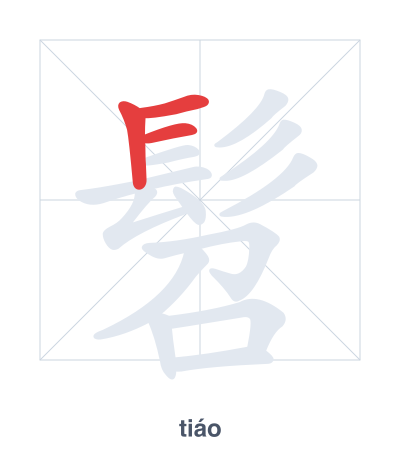
Ouvrez Hanzi Writer pour voir l'ordre des traits animé et pratiquer l'écriture de 髫 avec un retour en temps réel.
Le caractère 髫 (tiáo) s'écrit avec 15 traits. Suivez l'ordre des traits chinois standard : de haut en bas, de gauche à droite, de l'extérieur vers l'intérieur. Le radical 髟 est l'un de ses composants clés.
Pratiquez l'ordre des traits correct avec l'application Hanzi Writer pour voir un guidage animé trait par trait avec un retour en temps réel.
髫 signifie Enfance (cheveux d'enfant).
| Caractère | 髫 |
| Pinyin | tiáo (tiao) |
| Sens | Enfance (cheveux d'enfant) |
| Traits | 15 |
| Radical | 髟 |
| Difficulté | 4.2/5 |
髫 combines the radical 髟 (long hair) with the phonetic component 召 (zhào, to summon). In ancient China, children wore their hair in two tufts or braids hanging down, hence the character depicts hair in a youthful state, symbolizing childhood. The phonetic part 召 hints at the sound 'tiáo', while the radical emphasizes the hair meaning.
💡 Astuce mnémotechnique : Imagine a child with two little hair buns shaped like bells (召) hanging down, and when they run, the bells 'tiao tiao' ring, reminding you that 髫 means childhood.
垂髫指代小孩子。
chuí tiáo zhǐ dài xiǎo hái zi
Le terme 'Chuitiao' désigne les jeunes enfants.
他在髫年就很聪明。
tā zài tiáo nián jiù hěn cōng míng
Il était déjà très intelligent dans sa petite enfance.
髫龄时期非常快乐。
tiáo líng shí qī fēi cháng kuài lè
L'enfance est une période très heureuse.
Ouvrez Hanzi Writer pour voir l'ordre des traits animé et pratiquer l'écriture de 髫 avec un retour en temps réel.
✨ Ordre des traits animé · Reconnaissance de l'écriture · Pratique HSK graduée · Gratuit
La partie gauche, 髟, représente des cheveux longs et flottants, indiquant que le sens est lié aux cheveux. La partie droite, 召, donne le son 'tiáo' et agit comme un indice phonétique. Ensemble, ils décrivent les cheveux des enfants qui pendent, une caractéristique typique de la jeunesse dans la Chine ancienne.