芷 (zhǐ) means "Angelica (a fragrant plant)" in Chinese. It has 7 strokes with the radical 艹.
Rated 3.5/5 in difficulty (challenging).
Appears in 3+ common words including 白芷 (bái zhǐ), 芷若 (zhǐ ruò), 芳芷 (fāng zhǐ).
Due to its 7 strokes, Hanzi Writer's error detection shows 芷 requires focused practice — most learners need 10+ attempts for consistent accuracy.
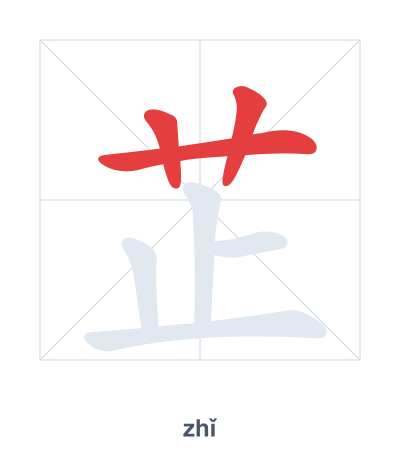
Open Hanzi Writer to see the animated stroke order and practice writing 芷 with real-time feedback.
The character 芷 (zhǐ) is written with 7 strokes. Follow the standard Chinese stroke order: top to bottom, left to right, outside before inside. The radical 艹 is one of its key components.
Practice the correct stroke order with the Hanzi Writer app to see animated stroke-by-stroke guidance with real-time feedback.
芷 means Angelica (a fragrant plant).
This character is a semantic-phonetic compound: the grass radical (艹) indicates it is a plant, while the component 止 (zhǐ) provides the pronunciation. Together, they represent the fragrant herb known as angelica (白芷).
💡 Memory Tip: Picture a patch of grass (艹) where a fragrant angelica plant grows, and a STOP sign (止) next to it, reminding you to pause and smell its scent.
妈妈买了白芷。
mā mā mǎi le bái zhǐ
Mom bought some Angelica dahurica (Dahurian Angelica root).
她叫周芷若。
tā jiào zhōu zhǐ ruò
Her name is Zhou Zhiruo.
这里的芳芷很香。
zhè lǐ de fāng zhǐ hěn xiāng
The fragrant herbs here are very sweet-smelling.
Open Hanzi Writer to see the animated stroke order and practice writing 芷 with real-time feedback.
✨ Animated stroke order · Handwriting recognition · HSK-graded practice · Free to use
芷 is made of the grass radical 艹 on top and 止 (zhǐ) on the bottom. The grass radical shows it is a plant, and 止 gives the pronunciation. Together, the character refers to a fragrant herb called Angelica.